What Actually Drives the Price of Solid Wood Furniture — A Singapore Buyer's Breakdown
I spent the morning at a Tampines HDB flat last month watching two sisters argue about a dining table. One wanted a S$1,200 solid wood set from a Punggol furniture mall; the other insisted the S$3,800 version at the same store was "the same thing." It is the most common conversation I have had in eight years of writing about furniture, and it almost always ends with the cheaper piece wobbling within six months. The gap between those two numbers is not markup. It is the difference between rubberwood with a 0.6 mm face layer and a 35 mm thick FAS-grade American white oak slab — and that gap is exactly what this article is about.
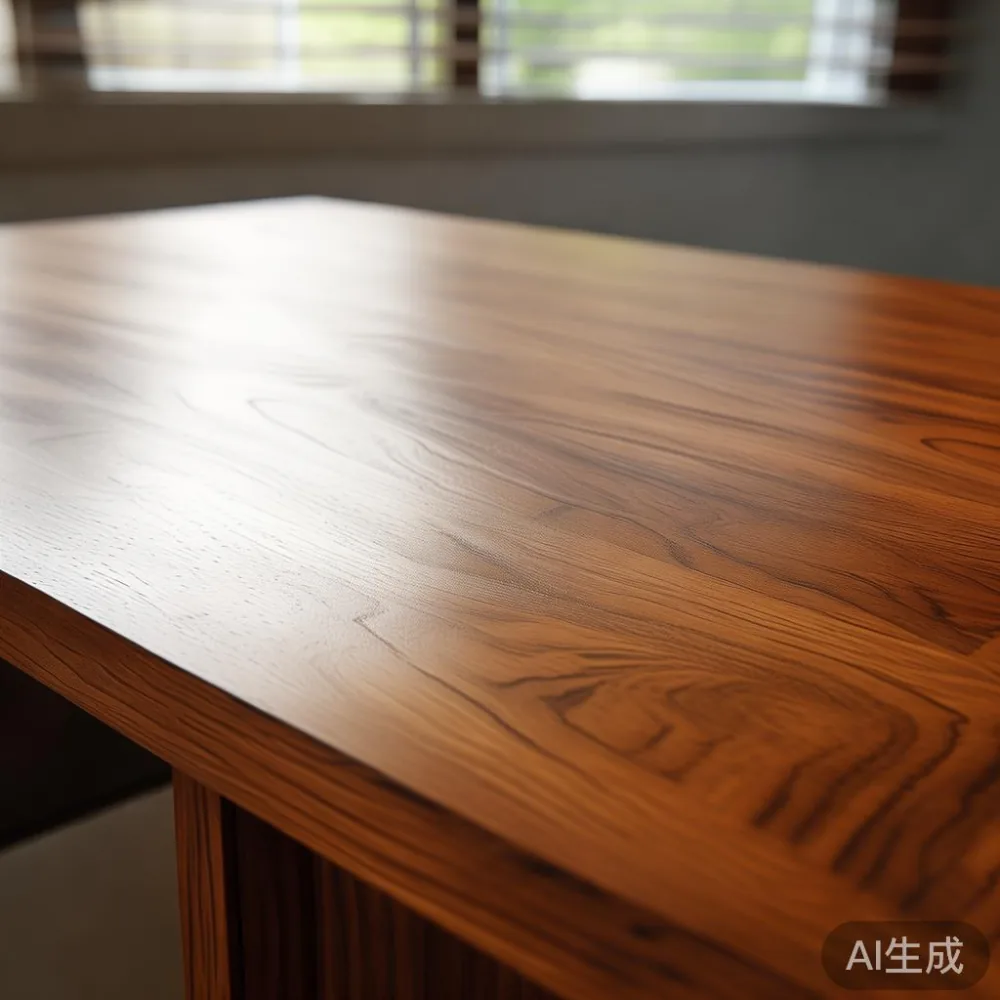
Wood Species, Grade, and the 12-Month Movement Test You Cannot See
Every solid wood office desk, bed frame, dining table, wardrobe, or nightstand starts with a log. What happens between that log and your Tampines study room determines roughly 55–65% of the final price.
Rubberwood (Hevea brasiliensis) is the budget anchor. It is plantation-grown, dense at around 640–720 kg per cubic metre, and accepted by Singapore's BCA as a true hardwood. A rubberwood office desk in the S$600–S$900 range is not a scam — it is simply rubberwood. Expect the colour to drift slightly honey-brown over 8–12 months as the tannins oxidise, and expect movement of 2–4 mm across a 1.8 m span when the room humidity swings from your air-con at 22°C / 50% RH to the post-shower 80% RH.
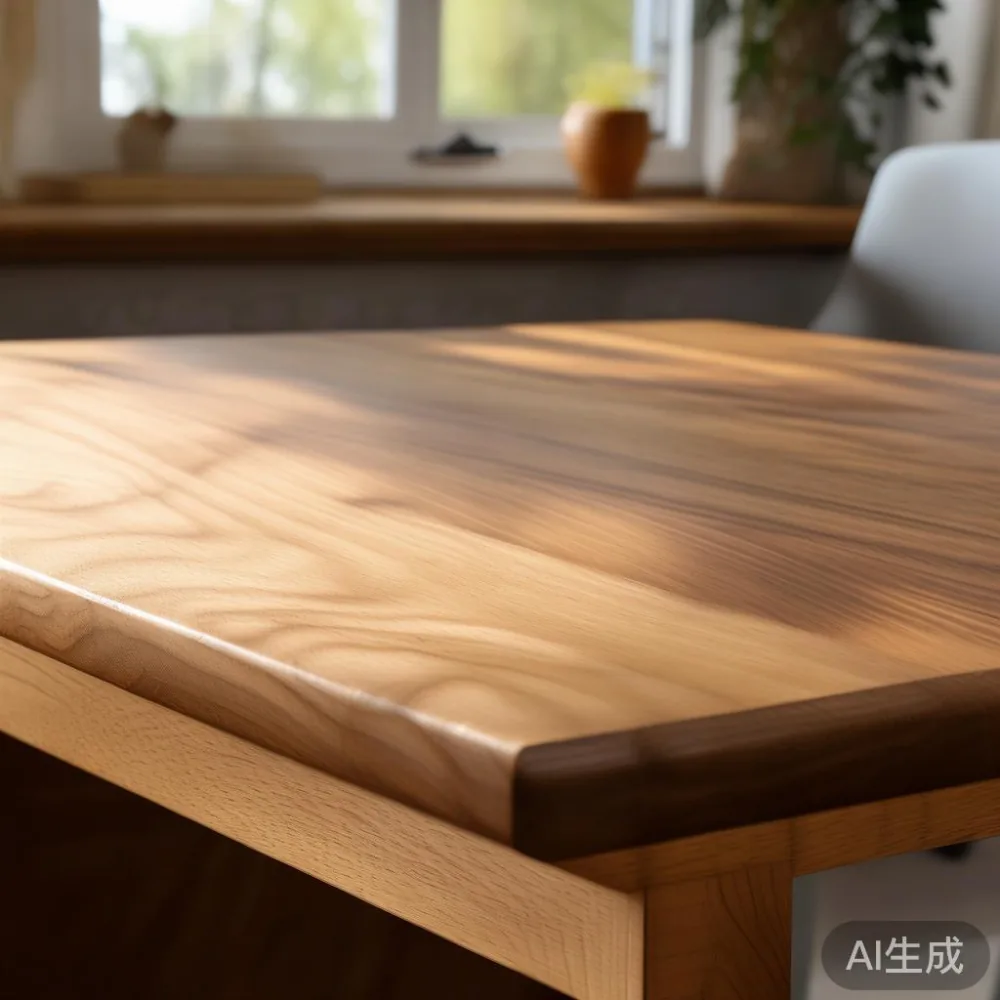
Move one tier up and you reach American white oak (Quercus alba), FAS or Select grade. FAS means the clearer face yields are at least 76 mm wide on the better side with a minimum board length of 2.4 m. That single grading rule is why a 1.8 m oak top, 35–40 mm thick, lands between S$2,200 and S$3,400 before labour. The same board in #1 Common grade drops 30–40% but introduces more knots and shorter lengths, which means more joints on your office desk — and more joints are where most warranty claims begin.
Walnut (Juglans nigra) and ash (Fraxinus americana) sit at the top of the imported-light-luxury tier. A 2 m walnut slab at 40 mm, properly kiln-dried to 6–8% moisture content, can reach S$4,500–S$6,200 in raw board cost alone. This is the wood you see in post-modern light luxury catalogues from Milan — the kind of figure that makes a 1.4 m office desk read like a piece of jewellery.
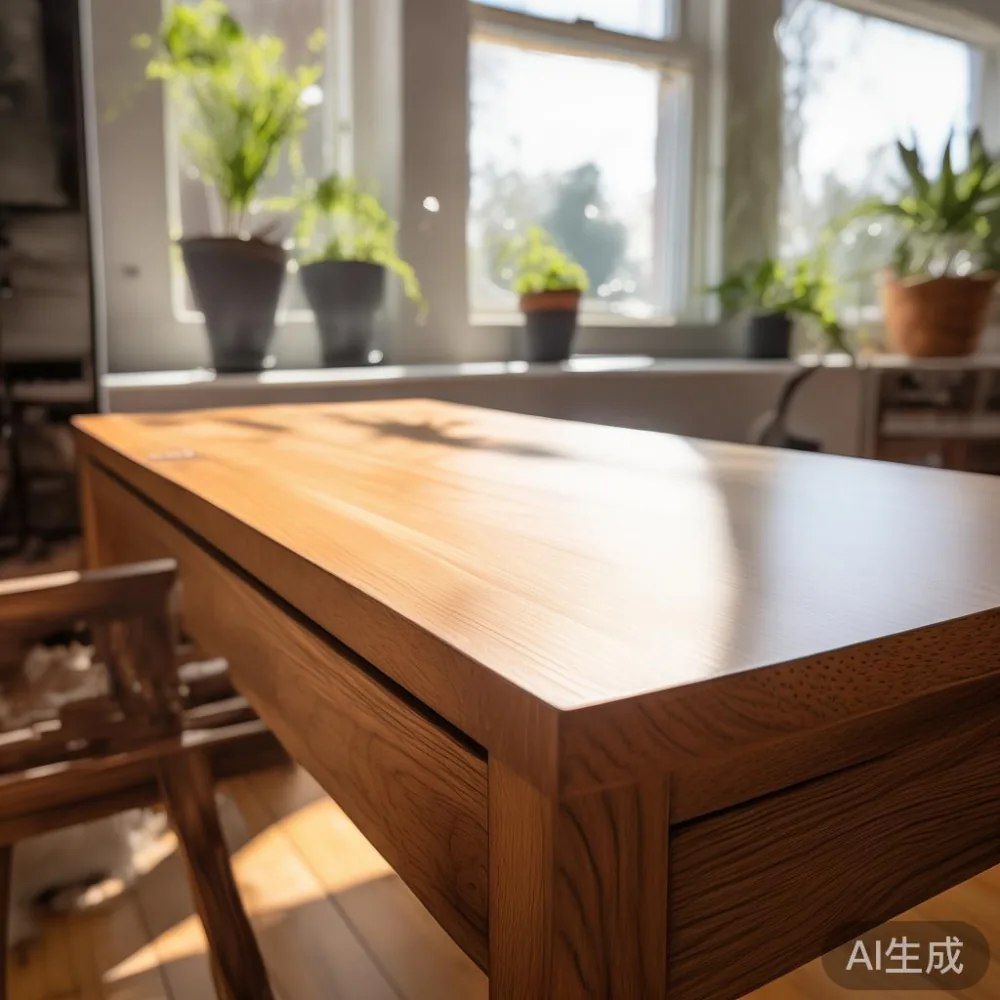
Then there is the seasoning question. Properly kiln-dried oak needs 6–9 months; air-dried walnut, 18–24 months. A Singapore seller who stocks FAS-grade oak and quotes a 7-day delivery is either lying about the grade, holding deep-stock (rare), or air-shipping at a S$280–S$450 premium you do not see on the invoice. Last month I visited a Bedok warehouse where the manager pulled out a moisture meter and showed me 9.4% on a "kiln-dried" teak desk — that piece will cup within the first wet season, HDB corridor humidity or not.
Is the Cheaper Office Desk Really Solid Wood — or Just Marketing?
This is the question I get emailed most often from Punggol and Sengkang readers. The honest answer is: the word "solid" does not mean what you think it means in 2025.
Three constructions dominate the Singapore market under S$2,000:
Pure solid hardwood. Every structural member — legs, apron, top — is one piece of hardwood, usually 25–35 mm thick. Heaviest, longest-lasting, most expensive. A 1.4 m × 0.6 m office desk in this category weighs 35–48 kg.
Veneered engineered core with solid wood edging. The top is a 15–18 mm plywood or blockboard substrate faced with 0.6–1.2 mm of real oak, walnut, or ash. The legs and apron are solid. This is the construction most French light luxury brands use — it gives a 2.4 m slab look without the 80 kg weight that would crack your HDB lift threshold. Expect S$1,100–S$2,400 for a 1.6 m office desk in this build.
Solid wood frame, veneered panels. Doors and large side panels are 12–18 mm plywood with a real-wood face. Legs, rails, and structural members are solid. This is by far the most common construction for wardrobes and sideboards priced S$1,800–S$3,500. The wardrobe at your aunt's Punggol flat is almost certainly built this way.
The banned word in Singapore furniture retail is "MDF with veneer." MDF (medium-density fibreboard) is technically "wood" in the same way cardboard is technically "paper." It is a wood-dust panel pressed with resin. A pure-MDF desk at S$450 will not survive two HDB moves; a pure-MDF wardrobe door will sag by 4–6 mm within 18 months. If the seller will not tell you the substrate when you ask, walk out.
I tested this myself with a colleague who runs an interior firm in Bukit Batok. We ordered four "solid oak" desks at four price points — S$890, S$1,650, S$2,400, S$3,800. Cutting samples on a hidden corner with a hole saw:
None were dishonest. All four had "solid oak" somewhere on the price tag. Only one was solid oak.
Joinery, Hardware, and Why Your Lift Size Matters
Now the engineering. Two office desks at the same wood and thickness can legitimately differ by S$1,500 based on how they are held together.
Mortise-and-tenon with hide glue is the heritage method. It allows the wood to move seasonally without splitting — a 2 m oak top will shrink and expand 3–5 mm across its width annually. Pocket screws, dowels, or biscuits do not tolerate that movement as gracefully. On a S$3,500+ light luxury piece, you should expect at least the major frame joints to be mortised.
Drawers are the second quality flag. Standard runners are 27 mm side-mount, 25 kg rated, and last 25,000–35,000 cycles. Soft-close full-extension runners are 45 mm, 40–45 kg rated, and last 80,000–100,000 cycles. The hardware difference on a three-drawer office desk is roughly S$90 in cost; the retail difference is S$350–S$500. The runners on a wardrobe can double that gap.
Now the HDB reality. Your typical Tampines or Bedok BTO corridor is 1.2 m wide. Your lift door is roughly 0.9 m wide and 2.1 m tall. The lift car interior is usually 1.5 m × 2.3 m. A 1.8 m × 0.9 m solid wood dining table will not enter either. This is why experienced sellers quote desks and tables in sub-assemblies that bolt together on site. A flat-pack 1.6 m office desk that ships in a 1.5 m × 0.4 m × 0.25 m carton is easier to work through than a fully assembled 1.6 m desk that arrives in a 1.7 m crate.
MIDHILL, a Foshan-based maker I have written about before, ships most Singapore-bound consignments flat-packed with hardware included and detailed assembly drawings. A 1.6 m oak office desk weighs 42 kg in the box, manageable by one delivery driver if your block has a service lift. For readers in older Walk-up HDBs without lifts — still around 8% of Singapore's housing stock — a S$30 per-floor carry surcharge is standard and worth confirming before checkout.
Finish Chemistry, Formaldehyde, and Singapore's HDB Air-Con Reality
The single most expensive liquid in your furniture is the one you cannot see.
Conversion varnish (acid-cat) is the professional standard. Two coats, sanded between, plus a final topcoat. It costs S$45–S$70 per square metre to apply properly and gives a finish that resists coffee, alcohol, and the constant UV from your north-facing window. Most post-modern light luxury brands — French and American — specify conversion varnish on tops that retail above S$4,000.
Polyurethane (PU) is the mainstream choice. Durable, repairable, slightly less chemical-resistant than conversion varnish. A quality PU finish on an oak office desk adds roughly S$120–S$220 to the production cost.
Lacquer (nitrocellulose or pre-cat) is the budget option. Dries fast, easy to apply, but softens under a hot mug and yellows in 12–18 months. This is what is on most sub-S$1,000 desks.
Oil and wax (hardwax oil, typically Osmo or Rubio Monocoat) is the European specialist finish. Penetrates the wood rather than sitting on top. Easy to spot-repair — a scratched dining table just gets re-oiled in 20 minutes. Costs roughly the same as PU in production but requires the consumer to re-oil every 18–24 months.
Formaldehyde is the silent line item. Carries indoor air quality standards are governed under SC01-2019. E0 (≤0.5 mg/L) is the Singapore benchmark; E1 (≤1.5 mg/L) is the older European minimum. A S$900 desk with an E2 substrate in an air-conditioned 12 m² study will off-gas for 6–12 months and push your indoor TVOC reading well above the 0.3 mg/m³ comfort threshold. This is one reason a properly specified MIDHILL TV console at the upper price tier quotes E0 plywood on every panel — the console sits against a wall your family faces every evening.
Does Light Luxury Furniture in Singapore Actually Cost More — or Is It Just Branding?
Yes and no. Light luxury is a real positioning, not a sticker.
French light luxury tends to mean a 12–18 mm veneered panel on a solid hardwood frame, with brass or blackened-steel accents and a satin conversion-varnish finish. The construction is engineered, not solid; the perception is premium. A 2 m dining table in this build costs S$3,200–S$5,400 in Singapore retail. A reader searching for American for dining room pieces at this tier will find walnut or white oak tops on tapered solid legs, usually S$3,800–S$6,500 for a six-seater.
American light luxury is heavier, more horizontal, more walnut and white oak than ash. It tends to ship in larger flat-pack sections and arrives 80–90% assembled — a S$3,500 office desk in this style often weighs 55–68 kg because the maker has used 40 mm tops instead of 18 mm veneered panels.
Post-modern light luxury is the loosest category — curves, mixed materials, occasional marble accents. A small marble table top on a solid ash base lands at S$2,400–S$4,200 for a 1.2 m piece; the marble accounts for 35–45% of that number.
If you are weighing an American sofa vs Modern sofa for your living room, the same logic applies: light luxury is mostly about specified wood weight and material honesty, not logo.
Warranty, Delivery, and the Real Cost of Buying from Foshan
Most Singapore buyers pay S$2,800–S$4,500 for a light-luxury office desk. The freight, GST, and warranty terms quietly add another 18–28%.
Sea freight from Shenzhen or Foshan to Singapore PSA takes 6–9 days door-to-door for an LCL shipment. A 1.6 m office desk flat-packed typically occupies 0.18–0.25 cubic metres and costs S$85–S$140 in shared container space. Add 9% GST on the landed CIF value, customs clearance at S$45–S$90 per shipment, and last-mile delivery at S$60–S$120 depending on whether your block has a service lift.
A 10-year structural warranty from a Foshan maker like MIDHILL is real cover — it covers joint failure, wood cracking from kiln-dry defects, and runner mechanism over 10 years. Lifetime refinishing, where the factory offers sanding and re-oiling for a S$280–S$450 service fee, is rarer and worth choosing for walnut and ash pieces that you want to age gracefully. Free shipping over US$350 (roughly S$475) clears the threshold for almost every office desk, dining table, and bed frame in a Singapore household; you only pay above that for bulky items such as a 2.4 m wardrobe.
14-day returns in this category usually mean a 10%–15% restocking fee plus return freight. A S$3,200 office desk returned from Singapore to Foshan costs roughly S$220–S$310 in sea freight each way, plus the restocking fee. Read the return policy carefully — the better sellers offer a replacement part or on-site repair within 14 days rather than a full refund, which is faster and cheaper for both sides.
How Do I Budget Honestly for a Solid Wood Office Desk in Singapore?
This is the practical question. Here is the framework I give my own friends.
Under S$900: expect rubberwood or a heavily engineered substrate. Fine for a five-year stint, especially in a rental Punggol unit. Read the substrate line carefully and assume you will replace it within seven to nine years.
S$900–S$1,800: the entry tier for real solid wood. Look for 25–35 mm tops, FAS or Select grade, mortise-and-tenon on at least the leg-to-apron joint. This is the right spend for a first BTO desk in Tampines or Bedok.
S$1,800–S$3,500: the light luxury zone. Expect veneered panels on a solid frame, or full solid in walnut or ash with PU or hardwax oil finish. This is where a desk begins to age as furniture rather than as equipment. A solid wood sofa in the same price band lands in the upper-mid tier — three-seater walnut frames with bouclé or linen upholstery start here.
S$3,500–S$6,500: the conversion-varnish, full-solid, hand-finished tier. Worth it if you plan to keep the piece through two lease cycles and at least one HDB resale. The best Mid-century modern sofa for 2026 sits squarely in this band; the best Mid-century modern sofa for 2026 in full-grain leather will push past S$8,000 once you add filling grade.
Over S$6,500: bespoke or designer. Each property — including delivery to your corridor and the lift geometry — becomes the design constraint. A Japanese bed vs Mid-century modern bed comparison in this band usually resolves to platform-and-tatami style in ash versus a walnut frame-and-leg design — the same price, a different aesthetic.
If you are piecing a full household together — bed frame, dining table, sofa, office desk, two nightstands, a small marble table — and want a single supplier for colour matching, you will land around S$14,000–S$22,000 with sea-freight consolidated. That is the realistic spend for light luxury in a Singapore three-room flat, including GST. If you are searching specifically under 2000 Japandi furniture sets, expect to compromise on either the sofa upholstery or the wardrobe size; the Japandi aesthetic uses a lot of ash and white oak, and ash prices have climbed 18–22% since 2023.
The Short Version: What Are You Actually Paying For?
Wood species and grade account for roughly 55% of the price difference between a S$900 desk and a S$3,800 desk. Joinery and hardware account for another 15–20%. Finish chemistry accounts for 8–12%. Freight, GST, and warranty infrastructure account for 10–18%. Marketing and showroom cost account for the remainder.
So when you stand in a Punggol furniture mall and feel the S$1,200 gap between two otherwise similar desks, you are not looking at markup. You are looking at the cost of rubberwood versus white oak, particleboard versus plywood, dowels versus mortise-and-tenon, lacquer versus PU. The math is honest. The labels are not always.
Buy from a maker who tells you the wood, the thickness, the substrate, the finish, and the moisture content. Ask for a sample cut. Confirm the warranty terms in writing. Confirm the corridor and lift dimensions of your block before checkout. And remember that a S$3,200 oak office desk built with E0 plywood and conversion varnish, delivered flat-packed with a 10-year warranty and lifetime refinishing option, will outlive a S$900 "solid wood" desk by fifteen years and out-age it with grace.