How to Choose the Right-Sized Office Desk for a Singapore HDB Living Room
Choosing an office desk for a Singapore HDB living room is rarely a matter of picking the largest model that fits the photograph. HDB layouts are compact, household routines are shared, and a desk must work for two people, a laptop, a monitor, and a stack of documents without making the room feel like a corridor. The useful question is not how much space can be squeezed in, but how much space can be used comfortably every day.
Last month I visited a family in Tampines with a 3-room flat whose living-dining area measured roughly 21 m². Their existing office desk was 160 cm wide, leaving only 74 cm between the desk edge and the television console. It looked acceptable in a showroom, but at 9 p.m. the chair had to be moved to let the youngest child pass. We replaced it with a 120 cm office desk with a 45 cm-deep top and a slim rear cable tray. The result was not merely smaller; the walking route became clearer, and the desk became usable for homework as well as paid work.
This guide focuses on one decision: choosing the right office desk size for an HDB flat or a similarly compact Singapore condo. It covers measurements, lift access, work comfort, cable management, and the value of materials such as solid wood. Product references such as a solid wood sofa, bed frame, dining table, wardrobe, nightstand, and marble table are included only to explain how a coordinated room behaves. They should not compete with the office desk or crowd out the living area.
What size office desk fits a typical Singapore HDB living room?
For a standard HDB living-dining space, a 100-120 cm office desk is usually the most practical range. A 100 cm model suits smaller 3-room flats or a combined study and display corner. A 120 cm desk gives a single user room for a 60 cm monitor, laptop, documents, and a drink without becoming obstructive. For two people working at the same time, consider 140-160 cm, but only if the desk is intended as a shared workstation rather than an occasional laptop table.
Depth matters as much as width. A desk under 50 cm deep may support a laptop but leaves little room for forearms, a keyboard, or a monitor placed at the correct distance. A 55-60 cm depth is more comfortable for daily computer work. A 70 cm depth is useful for drafting, editing, or a desktop PC, yet it can sharply reduce a living room’s apparent space. In many Tampines and Bedok flats, a 120 by 60 cm office desk offers the strongest balance between utility and circulation.
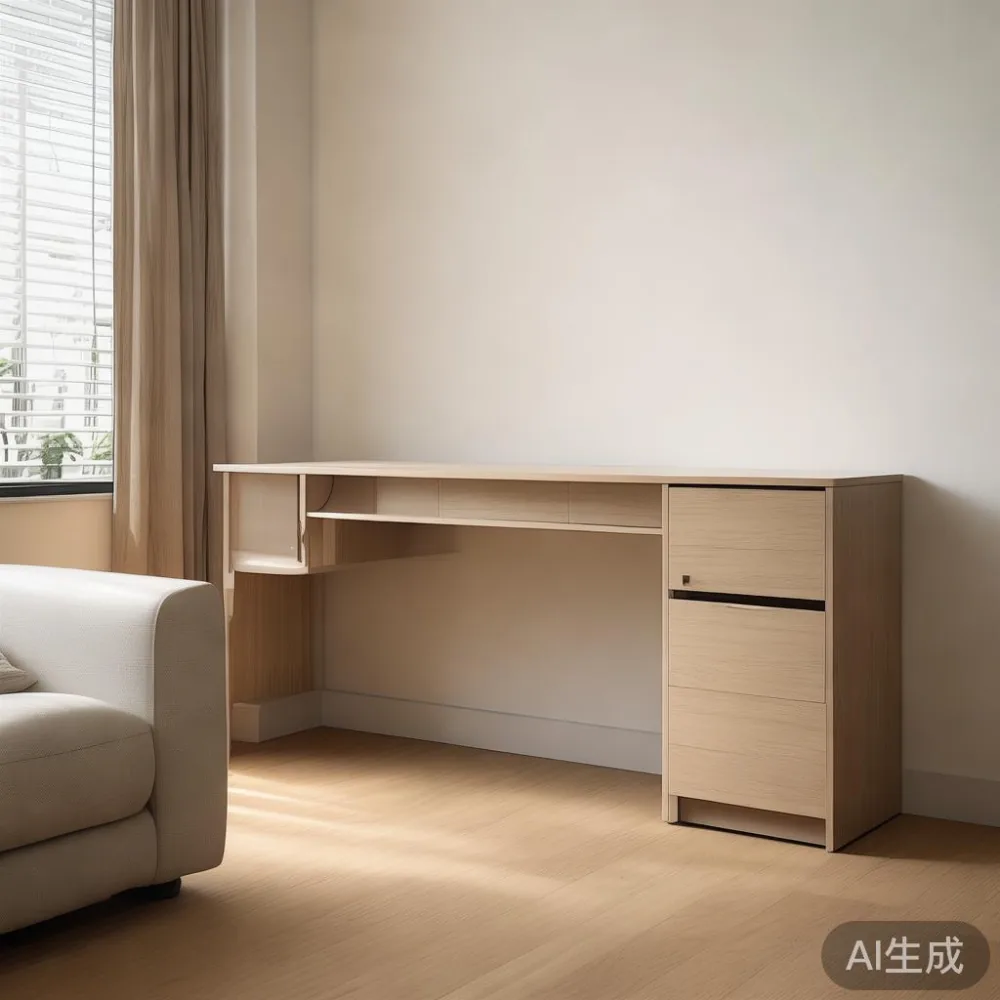
Do not measure only the furniture footprint. Add at least 75 cm for a seated work zone and allow about 90 cm behind it where the desk faces a wall. If the chair must be pushed back to pass the sofa or dining table, the available space is too tight for a full-time workstation. A desk that looks restrained in the room may still be wrong if the chair cannot move freely.
A practical sizing rule is: desk width should be at least 120 cm for one fixed monitor, 140 cm for a monitor plus full-size keyboard and papers, and 160 cm for a dual-screen setup. Height should generally fall between 72 and 76 cm for a seated adult. These are guidelines, not guarantees; a shorter user may need an adjustable model.
How do you measure an HDB living room before ordering an office desk?
Begin with a floor plan and record the narrowest part of the route from the lift lobby to the living room. HDB common corridors are often about 120-150 cm wide, while many passenger lifts have internal door dimensions near 90 cm. The largest upright panel of the office desk must fit through the lift doorway and turn into the corridor without striking handrails or neighbouring residents’ furniture.
Measure three things:
1. Maximum desk width: Tap a piece of tape on the floor where the desk will sit. If the width is exactly 120 cm, order a 110-120 cm office desk rather than a model that needs the full taped area. A desk wider than 130 cm may create a constant squeeze.
2. Usable wall length: Subtract 5 cm from the wall for sockets, skirting boards, and assembly tolerances. A 125 cm wall section can therefore carry a 120 cm office desk, but it should not be treated as 125 cm of usable working surface.
3. Chair pull-back: Place a 65-70 cm marker behind the desk. This represents the distance needed to sit down, roll the chair, and stand without colliding with a solid wood sofa or dining table. If the marker overlaps another object, move the desk or change its orientation.
Photograph the corner from standing eye level and from the doorway. Tape the proposed desk footprint on the floor for 2 days. This simple test reveals how the desk affects natural light and daily movement better than a showroom photograph can.
Are corridor and lift widths limiting factors for a solid wood office desk?
They can be. Singapore’s compact blocks make delivery access part of furniture selection, not an afterthought. A 140 cm office desk may look appropriate in the living room but fail to turn inside a 90 cm lift. Ask the seller for the packed dimensions, not only the assembled dimensions, and check whether the top can be separated from the legs.
Solid wood is attractive for an office desk because it feels substantial, resists minor marking, and suits French light luxury, American light luxury, or post-modern light luxury interiors. Yet a solid construction can also be awkward in an HDB access route. If the top is too thick to pass diagonally through the lift, a flat-pack or modular office desk may be more sensible.
MIDHILL’s 10-year structural warranty and lifetime refinishing service are relevant when a desk is intended for years of use, but access still needs to be planned. Confirm the delivery timeline in writing. A lead time of 15-25 working days is reasonable for a made-to-order or configured model, while stock pieces may arrive within 3-7 days. Singapore delivery costs should be quoted in SGD, and GST may be added unless the seller states that the displayed price is GST-inclusive.
For residents asking about for sale Japanese furniture, the key lesson is to check the actual route before selecting any imported piece. The same principle applies to under 2000 European light luxury furniture: an impressive office desk is useful only if it can enter the block and remain comfortable at home.
Which office desk shape works best in an open HDB living-dining area?
A rectangular desk generally handles closed rooms more efficiently than an L-shaped workstation. In an open living-dining area, place the office desk against the longest uninterrupted wall, preferably beside the television console rather than directly in front of it. A 120 by 60 cm model occupies 0.72 m², while a 140 by 70 cm model occupies 0.98 m². That difference of 0.26 m² sounds modest, yet it can determine whether a dining table can remain in place with 90 cm of pull-out clearance.
For a very small corner, a 90 by 50 cm laptop desk can work. It is more appropriate for light administration, reading, and short writing sessions than 8 hours of monitor work. If the desk will be shared by two adults, use two desks of 100-120 cm each rather than one 200 cm model; separate units can follow different walls and reduce congestion.
Corner desks look efficient because they wrap into two walls, but they often include deep side extensions that swallow usable floor area. A writing return of 35-40 cm is enough for papers or a printer. A return deeper than 50 cm may compete with the dining table. Floating desks are another option: because the floor remains open, they visually reduce clutter. However, the wall fixings must suit the substrate, and cable routing can be less tidy than with a conventional solid wood base.
Round or curved office desks can soften a rectangular HDB room, although they rarely create extra working width. Their advantage is psychological rather than dimensional: rounded corners make a narrow route feel less obstructed. The desk should still be chosen for its usable surface, leg clearance, and stability.
How much clearance should remain around an office desk?
Leave 75-90 cm behind the chair for movement, 60-75 cm in front for the legs of a seated user, and about 5 cm between the desk and a wall for cable connections. A desk positioned against the television wall should not block ventilation for the console. Keep the office desk at least 30 cm away from a marble table or other polished stone surface so papers, grit, and damp cleaning cloths do not scratch it.
The clearest circulation line should run from the flat entrance through the dining area to the balcony or utility zone. In a Punggol or Tampines family where the office desk shares the room with a dining table, keep at least 75 cm around the dining table when chairs are in use. If the desk occupies the only open route, consider a wall-mounted shelf for printers and stationery rather than widening the desktop.
Think about evenings as well as working hours. A study can feel spacious during the day and crowded at 8 p.m., when the office desk becomes a homework station and the living room becomes a shared leisure area. A 120 cm desktop can accommodate one adult and one child using slim laptops. For two children or two adults with full-size keyboards, 150-160 cm is more practical, provided the rest of the room can preserve a 75 cm passage.
Storage can narrow the desk without adding visual bulk. A drawer unit should be no more than 35-40 cm wide, or it may take the knee space needed for a chair. A slim 15 cm pedestal can hold stationery, while a separate 80-90 cm tall storage cabinet can take books and files. This is also where a coordinated wardrobe or nightstand should be considered in adjacent rooms rather than added beside the desk.
Will a solid wood office desk suit Singapore humidity and daily work?
Quality solid wood can suit Singapore conditions when it is properly finished and maintained. Ask whether the surface uses water-based lacquer, low-VOC coating, or an oil-wax finish, and obtain care instructions. Wipe spills promptly, maintain indoor humidity around 45-60%, and avoid leaving a damp cloth against the wood overnight. Singapore’s humidity commonly ranges from 60-80%, so occasional air circulation is useful.
Solid wood gives an office desk a stable, tactile quality that suits a solid wood sofa or solid wood bed frame nearby. It also complements an Italian light luxury accent chair more convincingly than a thin laminate desk. Still, tone and proportion matter: a heavy desk in dark walnut can overwhelm a small room, while pale oak or natural ash can create a lighter visual footprint.
French light luxury usually pairs clean profiles with warm finishes and restrained ornament. For this style, a 120 cm rectangular office desk with slim tapered legs and a matte natural-oak finish works well. American light luxury tends toward generous scale, which requires caution in an HDB flat. Post-modern light luxury can accommodate a mixed-material desk, such as a timber top with a powder-coated metal frame, but the combination should remain coherent with a marble table, bed frame, wardrobe, and nightstand elsewhere in the home.
There are plenty of options under 2000 European light luxury furniture, and cheap Italian light luxury furniture can be found through online marketplaces, yet price alone does not reveal joinery, finish quality, or dimensional accuracy. Compare the desk under and over the knees, check drawer movement, and inspect how cables pass through the back. A weight capacity of at least 80 kg provides a sensible baseline for a solid wood workstation carrying a monitor, laptop, and paperwork.
How should an office desk share space with a bed frame and dining table?
Keep the office desk visually connected to the work zone without turning the entire living-dining area into an office. One approach is to align it with the television console and a low storage wall. Another is to place it beside the dining table in the same material family. A solid wood dining table near a solid wood office desk can look intentional, but matching grain exactly across different furniture pieces is neither realistic nor necessary.
In a compact condo, furniture zones work better when one dominant material anchors the room. A warm solid wood bed frame in the bedroom may be paired with a matching-tone office desk and nightstand in the living room. The dining table can introduce a different surface or finish. If a marble table is present, choose a quieter desk finish so the stone remains an accent rather than the room’s loudest feature.
For bedrooms that double as studies, a full-size bed frame may consume more room than a small office desk can reclaim. A queen bed commonly measures 152 by 191 cm, and circulation around it can require another 60 cm on each side. Before placing an office desk in a bedroom, test the route from the bathroom door to the bed and confirm that a 70 cm-wide chair can open without touching the wardrobe.
These comparisons matter in requests such as American bed vs French provincial bed, where the visual weight of the sleeping area can influence the living room’s style. The best Nordic bed for 2026 may be compact and restrained, but it should not be chosen by trend language alone; its actual footprint must fit the room. A desk decision should use the same discipline.
What delivery and service details should Singapore buyers confirm?
Confirm 7 details before paying:
1. Packed size: Ask for the length, width, and height of the package, the number of cartons, and the assembled desk dimensions.
2. Lift access: Provide the lift door width and the narrowest corridor measurement. Some deliveries include carry-in but not dismantling or unpacking.
3. Installation: Check whether assembly is included and whether upper floors add a fee. In Singapore, a 2-person delivery to the unit lobby may cost around SGD 40-SGD 80, with higher charges possible for carrying an assembled piece above the 5th floor.
4. Timeline: Confirm production, dispatch, and delivery separately. Allow 15-25 working days for a configured desk and 3-7 days for a stock desk, subject to availability.
5. Price and tax: State whether the SGD price includes GST. For example, SGD 980 becomes approximately SGD 1,077.60 with 10% GST if tax is not already included.
6. Returns: Check the return window, restocking conditions, and whether assembled furniture can be returned. A 14-day return policy is useful, but size selection should still be based on measurements.
7. Warranty: A 10-year structural warranty should define its scope, while a lifetime refinishing service should specify whether labour, transport, and coating are included.
MIDHILL exports to more than 15 countries and was established in Foshan Lingzhan in 2008. Those details can reassure buyers about manufacturing continuity, but local access, clear communication, and accurate measurements remain decisive in Singapore.
How do you finalise the right-sized office desk for an HDB home?
Choose the desk by measuring the room, not by the lifestyle image. Mark a 100 by 60 cm, 120 by 60 cm, or 140 by 70 cm rectangle on the floor and live with it for 2 days. Check the chair movement, the route to the dining table, the television console, and the television viewing area. If the desk disrupts a main circulation path, reduce its width or depth before shortening the desktop.
For one adult working regularly in a typical HDB living room, 120 by 55-60 cm is the most balanced starting point. For a laptop-only station, 100 by 50 cm is often enough. For dual monitors, choose at least 140 by 60 cm. A shared family desk may need 160-180 cm, but separate 100-120 cm desks often preserve better circulation.
Finish selection should follow the room’s light. Pale solid wood helps a compact space feel open; darker timber creates contrast and can work well when the surrounding furniture remains light. The office desk should coordinate with a solid wood sofa, bed frame, dining table, wardrobe, nightstand, or marble table without every item demanding equal attention.
The right office desk fits the work, the chair, and the household. It offers enough surface for a normal workday, leaves a clear route through the room, enters through the lift without damage, and remains comfortable at 6 p.m. rather than merely photogenic at noon. Measure carefully, compare the assembled and packed dimensions, and leave 75-90 cm behind the chair. Those few centimetres are what turn a piece of furniture into a usable workstation in Singapore home.