Solid Wood Pricing Insights: Uncover the Factors
Solid wood furniture is often sold on a simple promise: it will look warmer, last longer, and cost more than a flat-pack alternative. The reality is more useful. The price of a solid wood dining table, bed frame, wardrobe, or office desk is driven by a chain of decisions that begins before the timber reaches the factory and continues through delivery, installation, and after-sales care.
For Singapore buyers, those decisions are shaped by practical constraints: HDB flat doorways, common lift dimensions, narrow condo corridors, tropical humidity, and GST-inclusive budgets. A 180 cm table may fit a Tampines dining area but still fail to clear the turn beside a Bedok lift. A 160 cm office desk can be attractive in a showroom and frustrating in a Punggol home office if cable openings, drawer travel, and lift access were overlooked.
This guide examines the actual price drivers, using office desks and other solid wood products as examples. MIDHILL makes furniture for international buyers and offers a 10-year structural warranty, lifetime refinishing, 14-day returns, and free shipping above US$350, equivalent to roughly SGD 470 before local GST. The point is not that one specification automatically deserves a higher price, but that informed comparisons are much fairer than comparing furniture by species name alone.
Is timber species the biggest factor in solid wood furniture pricing?
Wood species matters, but “solid wood” is too broad to be a pricing category. It can describe oak, ash, beech, rubberwood, teak, walnut, and other materials with very different densities, working properties, and supply histories. An engineered board may also contain solid wood veneers. A solid slab dining table has a different cost structure from a solid wood sofa frame or a veneer-faced wardrobe.
Oak and ash are often chosen for their visible grain and structural strength. Walnut usually carries a premium because of its figure, colour, and more constrained supply. Rubberwood and other locally available species can offer a different balance of appearance and cost. Teak’s reputation for weather resistance creates demand beyond furniture, which can affect its price.
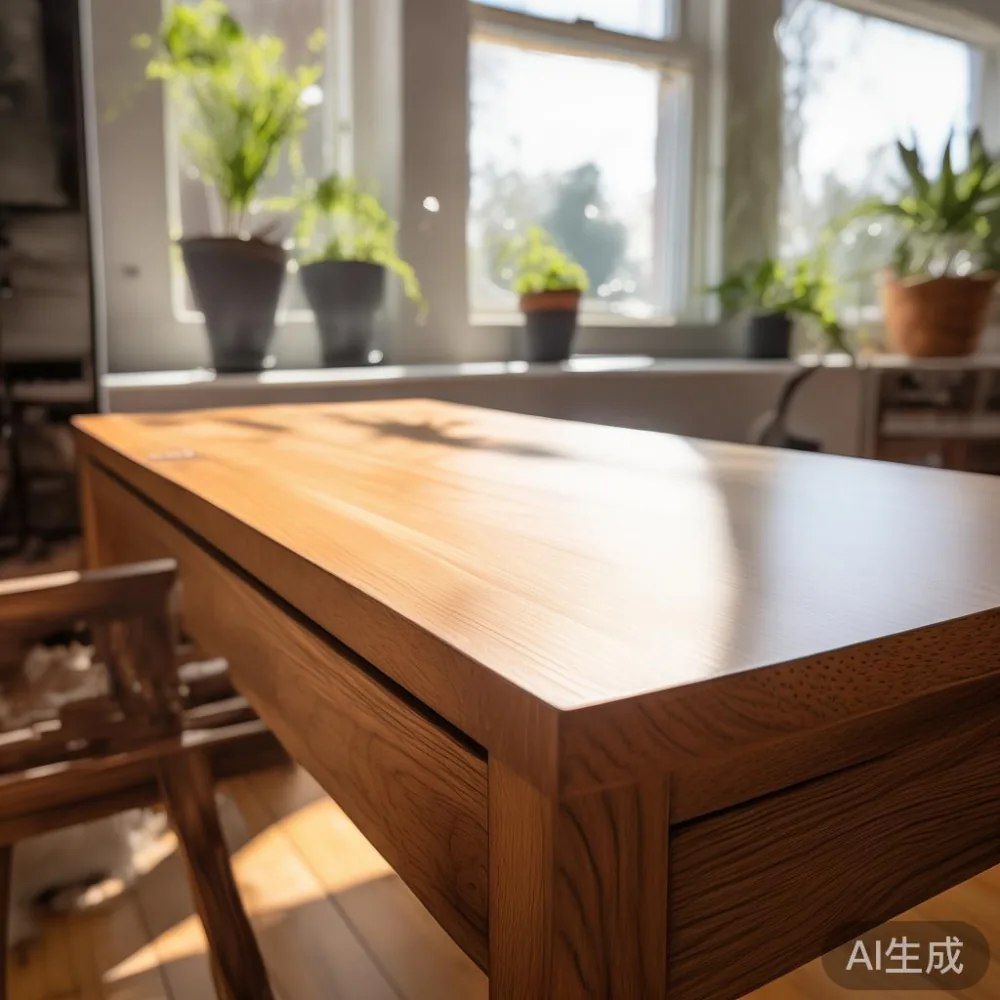
The harder question is what lies beneath the finish. In a well-made office desk, look for solid timber in the top, apron, legs, drawer boxes, and back panel—not merely a thin surface layer. Veneer can be entirely appropriate for some applications, but it should be described accurately. A seller who confirms board construction, veneer thickness, and joinery is more useful than one who simply says “solid wood.”
Price should also reflect drying and stability. Wood that is properly kiln-dried for Singapore conditions should have moisture content controlled for approximately 8–12%, depending on the species and manufacturing process. Rapid movement after delivery can create gaps, cupping, or joint movement. Factory acclimatisation is not decorative; it is part of the product.
For buyers researching how to choose European light luxury wardrobe, examine the internal construction rather than relying on a style label. A 200 cm wardrobe with hardwood rails, solid drawer boxes, adjustable shelving, and durable runners may be more convincing than an ornate 220 cm model whose back panel is thin and whose hardware is unspecified.
How much do dimensions and engineering add to the price?
Dimensions affect material use, but the relationship is not linear. A 140 cm office desk does not automatically cost 70% less than a 280 cm office desk because smaller components sometimes carry disproportionate setup, machining, packaging, and freight costs. Large tables also need larger crates, reinforced packaging, and more careful handling.
A useful comparison starts with the top and apron dimensions. A 160 × 70 cm office desk with 2 cm timber, a 55 cm working height, and a 140 cm pencil return provides a substantial work surface without swallowing a compact HDB study. A 180 × 80 cm model offers more legroom and monitor space, yet can be harder to manoeuvre through a 90 cm doorway or around a narrow lift lobby.
Joinery often separates economical construction from durable construction. Mortise-and-tenon joints, dowelled drawer parts, bridle joints, and reinforced corners take more machine time and skill than simple screws into particleboard. Hardware adds cost too: a steel ball-bearing drawer runner, a soft-close mechanism, and adjustable cabinet hardware can add meaningful amounts to a wardrobe or office desk. Transparent details about these choices help explain the final figure.
Weight is another driver. A solid wood dining table weighing 55–75 kg may require two-person delivery and a larger lift booking. A 35 kg office desk may fit through a standard lift but still need its carton turned vertically. The actual route should be checked against door width, corridor turns, lift door measurements, and lift capacity. Singapore lift capacity is commonly stated in kilograms, but building-specific limits vary, so management should confirm the permitted load.
I visited a supplier’s workshop last month and watched a 220 cm solid wood dining table being checked before packing. Its top weighed 68 kg, the apron was 7 cm deep, and the corner joints were assembled with dowels and glue beneath clamping pressure. The final packing crate measured 232 × 96 × 18 cm. That packaging and handling requirement explained more of the price than the decorative edge profile did.
Why do finishes, hardware, and tolerances affect a furniture price?
Surface finish is frequently misunderstood. “Natural finish” may mean clear lacquer, oil, wax, stain, or an open-pored treatment. Lacquer generally gives easier daily cleaning and a more consistent appearance; oil can be maintained by the owner but may need refreshing. A matte finish can conceal scratches better than a high-gloss surface, while a dark stain adds colour and processing steps.
Quality control creates another price difference. On an office desk, the drawer should align, the cable port should be cleanly cut, and the top should be flat within a sensible tolerance. On a bed frame, joints and supports should remain secure under cyclical loading. On a nightstand, drawer runners and stops should feel controlled. On a wardrobe, doors need consistent gaps and shelves should sit level. These details require measurement and assembly time.
Hardware specifications deserve direct questions. Ask for runner type, hinge type, screw composition, and the expected load rating for wall-mounted shelving. A 6 mm screw into a hollow wall may be less suitable than a properly installed 8 mm anchor. Hardware claims such as “30,000 cycles” should be treated as laboratory figures rather than a guarantee for every household condition.
Finish choices also interact with light-luxury design. French light luxury tends to pair pale woods, softened profiles, and restrained hardware. American light luxury often emphasises generous proportions, neutral upholstery, and substantial timber details. Post-modern light luxury can mix woods, geometry, and contrasting textures. These approaches may share similar construction, so two pieces can cost differently because of design development, scale, or component sourcing—not because “European” is a quality grade.
Design language has to fit the room. Italian light luxury sofa is a useful search phrase when evaluating upholstery and silhouette, but the frame underneath should receive the same attention as the exterior. The seat platform, suspension, corner blocking, and removable covers all affect service life and replacement cost.
What role do protective coatings and tropical conditions play?
Singapore’s humidity makes finish selection and care instructions important. A product that has been finished for the local environment should have a clear maintenance plan. Avoid placing a solid wood office desk directly against an air-conditioning vent or in a persistently damp position. Aim for sensible indoor conditions, typically around 20–30°C, and use a coaster or mat rather than leaving a laptop or wet glass on the timber.
Solid wood furniture expands and contracts as humidity changes. Small seasonal movement of 2–4 mm across a wide top can be normal, especially with a solid construction and carefully designed joints. A warped or cracked top, by contrast, may signal inadequate moisture control. Temperature changes near windows matter too: direct afternoon sun can heat a dark surface beyond 40°C and accelerate finish wear.
Pest treatment can also influence cost, although treatment should be specified rather than presented as a substitute for correct storage. Useful details include the timber treatment process, sealant used on end grain, and guidance for long-term storage in cartons. A furniture company that supports refinishing over a product’s lifetime is investing in repairability and appearance over time, not promising that a surface will remain untouched.
Care should be realistic. Dust with a soft cloth, clean spills promptly, and avoid abrasive pads. If an oil finish looks dry after 12–18 months in a well-used room, it may need maintenance. If a lacquered surface is scratched, repair options depend on the coating. Clear instructions help preserve value and prevent avoidable damage.
How are shipping, GST, and delivery services included in the final cost?
International freight, insurance, packaging, customs handling, and local delivery can be a substantial share of a furniture order. Heavy, bulky goods cannot be compared with parcel shipping. A solid wood office desk may need a dedicated delivery appointment and two or more handlers. A marble table may require even more protection because its surface is brittle and difficult to repair if struck.
Before ordering, request the packed dimensions—not only the assembled dimensions. Add about 10 cm to the packaged length and width as a planning allowance for trolley clearance, then compare that envelope with the lift door, corridor, stairwell, and entry door. Measure the narrowest turn as well as the straightest opening. A 91 cm lift door with a 120 cm-deep car can still create a difficult diagonal approach for a long package.
Some projects involve searching for under 2000 Scandinavian furniture, often with an assumed Singapore-dollar budget. That total should include GST and delivery, not only the product price. At the current 9% GST rate, a SGD 1,800 item becomes SGD 1,962 before transport and access charges. Budgets should also allow around SGD 50–150 for a normal local delivery to an HDB unit and more if upper-floor handling or a special lift booking is needed.
Delivery time should be stated in both production and logistics stages. A production period of 30–45 days is common for made-to-order timber furniture, followed by 7–21 days for international or regional transit, depending on destination and customs. If a buyer needs furniture for a new condo handover, ordering 8–12 weeks ahead is more prudent than assuming every item is held in stock.
MIDHILL coffee table wholesale may be relevant to hospitality buyers comparing container economics with showroom pricing. Volume discounts can help, but the buyer should also confirm carton dimensions, maximum pieces per container, assembly requirements, and the cost of returning or replacing transit-damaged parts. Wholesale pricing without a clear logistics plan can create an expensive surprise at the port.
What should a fair solid wood price comparison include?
A fair comparison should use the same checklist for every product. Record the species or verified material type, top thickness, dimensions, joinery, hardware, finish, packed weight, warranty, delivery terms, and return conditions. A written quotation is more valuable than a rounded figure in a showroom conversation.
For an office desk, ask whether the main top is solid timber, how thick it is, what supports the rear, and whether the return is supported. Confirm the working height, leg clearance, drawer dimensions, and cable-management openings. In Singapore, a desk depth of 60–70 cm often suits compact rooms; 70–80 cm provides more depth for a monitor arm and paperwork. A clearance of at least 65 cm below the top is useful for many users, while a wider return can support a second screen.
Ask the same questions of a solid wood sofa, bed frame, dining table, wardrobe, nightstand, and marble table. “Solid wood” does not mean every visible or hidden component uses the same timber. Marble tables have different weight and fragility considerations. Bed frames need adequate centre support. A sofa needs frame and suspension specifications. A nightstand needs stable proportions and usable drawer space.
Warranty terms can reveal how a manufacturer expects the product to be used. A 10-year structural warranty may cover certain defects under stated conditions but may exclude ordinary finish wear, accidental damage, or commercial misuse. Lifetime refinishing should define what service is included, whether refinishing is available for selected products, and whether labour or return freight is covered. A 14-day return period is also clearer when the item’s condition, assembly, and custom-made status are stated.
Modern light luxury for hotel procurement brings repeated-use requirements into focus. Contract buyers should review contract documentation, fire-safety information where applicable, replacement quantities, spare hardware, installation, and maintenance schedules. A 5 mm veneer on a bedside cabinet may be perfectly reasonable for a hotel, while an office desk used intensively every day may justify a thicker top and heavier-duty runners. Use determines the specification.
How can buyers identify fair value without chasing a headline number?
Start with function, measure the route, and then price the construction. An office desk that fits the HDB study and survives daily use may represent better value than a larger model with awkward delivery. A dining table with stable joints and a repairable finish may be more sensible than one whose price rests mainly on an elaborate edge. A wardrobe should be judged by internal fit and hardware, not only its front elevation.
For local projects, provide the supplier with door, lift, corridor, and turning measurements. Confirm whether stairs, carrying fees, upper-floor access, or assembly are included. For an office desk in a Tampines HDB flat, request a trial or dimensioned drawing before production. The same disciplined comparison applies in Bedok and Punggol, where corridor turns and lift approaches differ from one block to another.
Buyers can request samples and full quotations. For timber, check the tone and grain in daylight. For finish, understand cleaning and renewal. For mechanisms, test drawers, doors, and cable access. Keep the documentation, including the product dimensions, packed dimensions, weight, warranty, and delivery lead time. That record prevents a low initial price from becoming a costly installation problem.
Price is ultimately the sum of decisions: timber and moisture control, dimensions, engineering, hardware, finish, quality checks, protective packaging, freight, local delivery, warranty, and service. Once each decision is visible, the quotation becomes easier to understand. The goal is not simply to spend more, but to pay for the features that will matter in the room for the next 5, 10, or 15 years. For pricing or project enquiries, MIDHILL can be contacted at +86 188 2788 2512, with final Singapore costs confirmed in SGD, including GST and delivery scope.