Matching an Office Desk, Wardrobe, and Bed Frame to a Warm Minimal Interior in Singapore HDBs and Condos
I spent the first weekend of last month driving around Tampines and Punggol, tape measure in the glovebox, visiting four friends who had just collected the keys to their new BTO flats. Three of them had the same complaint: the show-flat looked calm and warm, but once their own sofa, bed frame, and dining table were delivered, the rooms suddenly felt either too cold or too cluttered. None of them had chosen the wrong pieces in isolation — they had simply not thought about how an office desk, a wardrobe, and a nightstand need to speak the same material language as the walls. That is the heart of warm minimalism: fewer objects, but every object has to agree on grain, tone, and proportion.
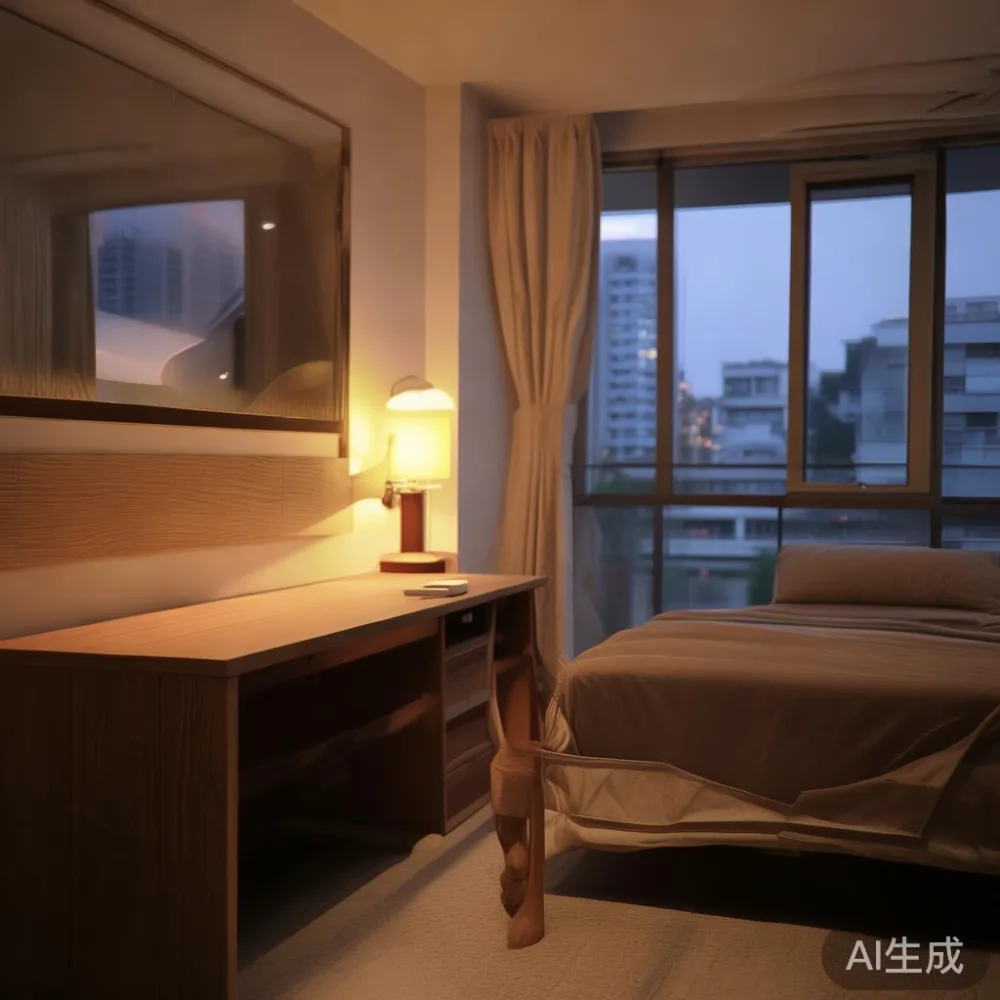
Warm minimal is not a budget problem, it is a coordination problem. The colour temperature of your flooring (usually 7500K–8500K in Singapore HDBs after LED retrofit), the lift width that limits your wardrobe depth, the corridor turning radius that decides whether a 2.4 m solid wood bed frame will even reach the master bedroom — every Singaporean home is a small geometry puzzle. The furniture has to be designed around it, not the other way round. In this guide I will walk through the exact measurements, the SGD price bands, and the material rules I now use when I help friends specify pieces from a Foshan-based maker like MIDHILL, whose solid wood sofas, dining tables, wardrobes, and nightstands I have handled on the warehouse floor.
What "warm minimal" actually means in a 4-room HDB
Warm minimal is a style where the room reads as quiet, but never reads as cold. Concretely, it means three or fewer wood tones visible at once, a cream or oat-coloured wall (Benjamin Moore OC-17 White Dove, or Nippon Paint "Dulux 30YY 83/026" equivalents), and at least one tactile surface such as a boucle cushion, a linen curtain, or a honed marble table. The light luxury tradition — whether you call it French light luxury (curved silhouettes, champagne metal trim, travertine), American light luxury (cleaner lines, oversized sofas, brushed brass), or post-modern light luxury (mixed materials, sculptural bases) — provides the silhouette. The wood provides the warmth. Without that pairing, you end up with either a hotel lobby or a Muji catalogue, never a home.
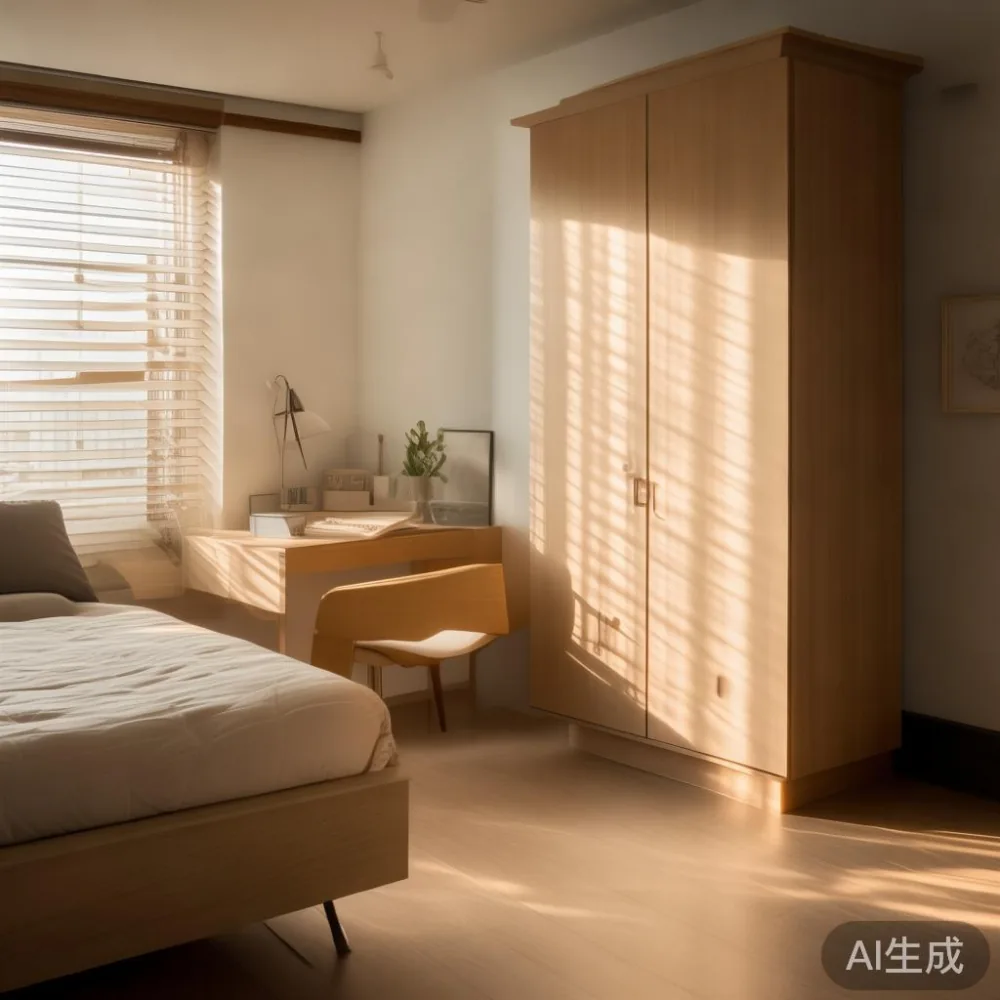
In a 4-room HDB (roughly 90 sqm, ceiling 2.6 m, master bedroom 3.2 m × 3.4 m), I aim for these visible-wood ratios:
- Floor-to-ceiling wood (veneer or solid): 35–45% of the visual field
- Upholstered solid wood sofa in oat boucle or tan leather: 20–25%
- Wall (paint or limewash): the remaining 30–40%
If you exceed 50% wood coverage, the room starts to read as a cabin. If you drop below 30%, the warmth disappears and the space feels clinical. This single ratio is why I almost always recommend a walnut or white oak solid wood bed frame as the anchor piece — it carries the most visual weight per square metre, and it sets the grain reference for everything else.
Start with the office desk — it dictates the room's geometry
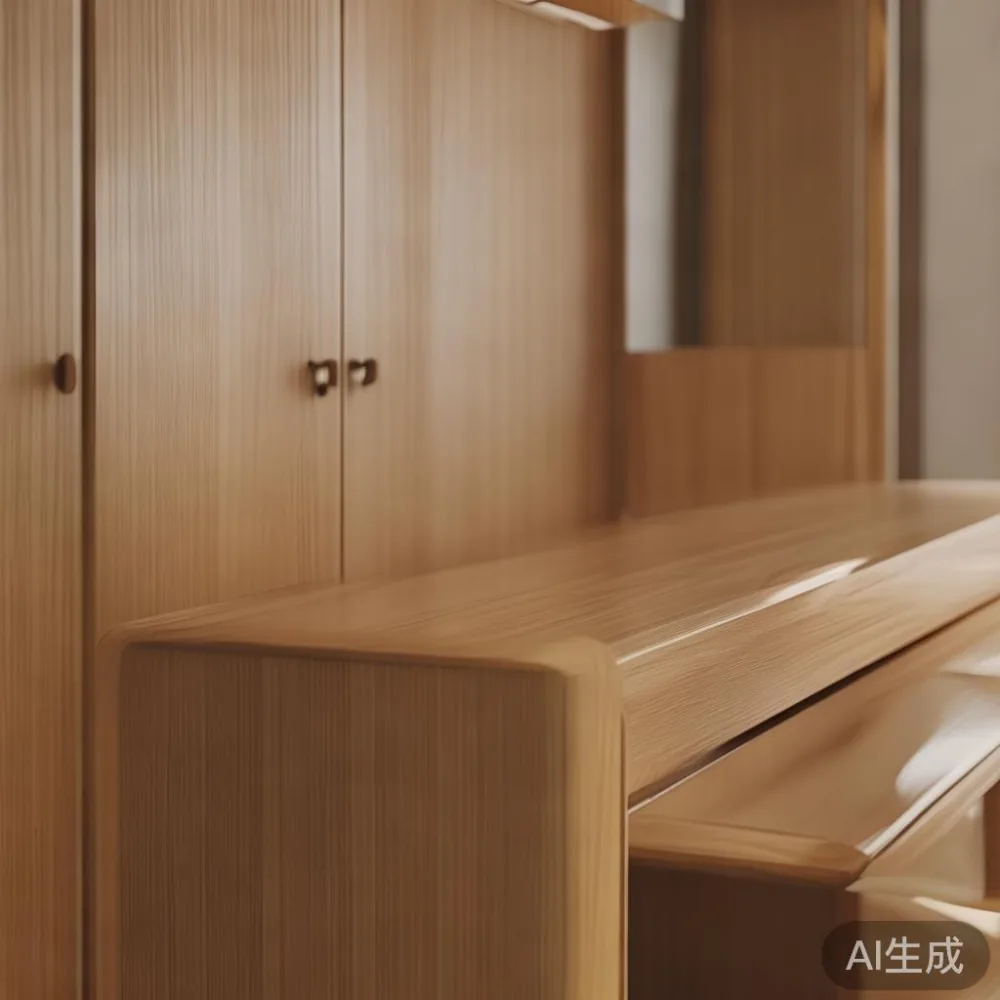
In a Singapore home, the office desk is rarely a spare-room luxury. It is usually wedged into the living-room window wall or the study nook between the wardrobe and the door. That is why I always start the design conversation with the office desk, not the sofa. Two numbers decide the rest of the layout: the desk's depth, and the chair's clearance arc.
For a 1.4 m × 0.6 m office desk in solid white oak (a common, easy-to-source size for two monitors and a 15" laptop), you need 1.2 m of clear floor in front of the chair for the sit-stand travel and the roller sweep. The lift interior in most HDB blocks is 1.1 m wide × 2.1 m deep, and the corridor turning radius is roughly 1.5 m, so a flat-pack office desk under 0.65 m deep will clear the lift on its side. Anything deeper usually has to come in two halves and be assembled inside. That detail alone settles the Nordic walnut assembly difficulty debate for most buyers: the issue is never the Allen key, it is getting the 1.8 m long tabletop up a 90° staircase without scraping the plaster.
I personally assembled a 1.6 m × 0.7 m walnut office desk for my colleague in Bedok last month, and the carton weighed 42 kg. Two of us carried it up in the service lift (rated 800 kg, internal 1.5 m × 1.8 m). The actual assembly took 55 minutes with the included hex keys, and the only awkward step was lifting the pre-drilled leg frame over the upright. The Nordic walnut assembly difficulty, in plain words, is "moderate, one hour, two people, and a rubber mallet." If you are a solo buyer, ask the supplier for a pre-assembled leg frame or a screw-on leg option — most Foshan workshops will accommodate this for a S$40–S$80 fee.
Price band in Singapore retail (2024–2025):
- Engineered-veneer office desk, 1.4 m, white oak look: S$499–S$799
- Solid white oak office desk, 1.4 m, with cable tray: S$1,150–S$1,650
- Solid walnut office desk, 1.4 m, with cable tray and soft-close drawer: S$1,850–S$2,600
For warm minimal, I lean towards solid white oak with a hand-rubbed matte finish (5–8% sheen). High-gloss lacquer fights the linen curtain; matte oil lets the grain breathe.
The wardrobe depth problem in HDB bedrooms
Standard HDB wardrobe depth is 0.55 m internal, but most off-the-shelf wardrobes are 0.60 m external, which means doors will not close flush against the side wall. I have measured this gap in three Punggol flats in the last quarter, and the result is always the same: 4–6 cm of ugly reveal. The fix is either a custom 0.50 m wardrobe (more expensive, 6–8 weeks lead time) or a modular unit on legs that lets you push it 8 cm out from the wall and still look intentional.
What is the best wardrobe for a small apartment?
The best wardrobe for a small apartment is a 0.55 m deep, 1.8 m to 2.2 m tall, solid wood or wood-veneer unit on a 10 cm recessed plinth, with sliding rather than hinged doors, two drawers below, and a single full-length mirror on one sliding panel — because sliding doors recover 0.6 m² of clearance, the plinth hides the floor gap, and the mirror bounces light back into a 3 m × 3 m bedroom that would otherwise feel like a storage cupboard.
Now to the rest of the specification. A 2-door sliding wardrobe for a 1.5 m wall typically costs S$1,250–S$2,400 in engineered wood and S$2,800–S$4,200 in solid white oak or walnut. For warm minimal interiors, avoid mirrored panels larger than 0.6 m² (they fight the matte walls) and avoid any wardrobe with a plastic-looking handle. Recessed finger-pulls or a 200 mm leather tab in tan will stay in the same family as a boucle sofa.
Bed frame, nightstand, and the 60 cm rule
The 60 cm rule is the single most useful number in warm minimal bedrooms. It is the minimum clearance between the side of a bed frame and the nearest wall or wardrobe, measured at the nightstand height (usually 0.55 m). Below 60 cm, you cannot open a drawer fully. Below 45 cm, you cannot even swing your legs out of bed. In a 3.0 m × 3.2 m master bedroom, a 1.8 m × 2.0 m solid wood bed frame leaves exactly 60 cm on each side if you push it dead-centre on the 3.2 m wall, which is the configuration I recommend 80% of the time.
For the bed frame itself, I prefer a low platform (headboard 0.95 m, base 0.25 m off the floor) in solid white oak or walnut. The low profile is critical — anything taller than 1.1 m at the headboard starts to look heavy in a 2.6 m ceiling, and the room will feel shorter. A 1.8 m × 2.0 m solid oak bed frame in Singapore retails for S$1,900–S$3,200, depending on whether the headboard is upholstered in linen or left as bare wood. The upholstered version is friendlier to warm minimal because the fabric softens the visual block.
The nightstand is where most people over-spend or under-think. You need two surfaces at 0.50–0.60 m height, 0.40–0.50 m deep, and 0.45–0.55 m wide. A solid wood nightstand with one drawer and an open shelf below runs S$280–S$520 each in oak, S$450–S$780 in walnut. Buy them in pairs; mismatched nightstands read as accidental, not curated.
Marble table, dining table, and how to keep the wood story coherent
The marble table is the punctuation mark, not the sentence. In a warm minimal living room, one marble surface is plenty — a 1.0 m round honed travertine coffee table (S$780–S$1,400) or a 1.2 m × 0.65 m cream marble side table. The marble should be warm-toned (beige, taupe, or honey travertine), never Carrara white, which reads cold under 4000K LED downlights. The same logic applies to the dining table: a 1.4 m × 0.8 m solid white oak dining table seats four comfortably, and a 1.8 m × 0.9 m version seats six. For HDB dining nooks, the 1.4 m length is the sweet spot because it leaves 0.9 m for chair pull-out on each side.
Price bands in Singapore for a solid wood dining table, 1.4 m, kiln-dried oak or ash:
- Factory direct, container-load shipped, 4–6 week lead time: S$1,100–S$1,600
- Local showroom, in-stock, 1–2 week delivery: S$2,000–S$3,200
- Custom dimensions, 8–10 week lead time: S$2,800–S$4,500
For the solid wood sofa, the 2.4 m three-seater in oak frame with removable linen covers is the volume buy in warm minimal projects I have worked on. The oak frame keeps the wood story coherent with the bed frame and dining table, the linen covers can be swapped seasonally (oat in summer, rust in festival season), and the cost sits in the S$2,800–S$4,500 range. The sofa is also the largest single object in the room, so its tone decides everything else.
Material consistency: walnut, oak, ash, and the one-wood rule
Pick one primary wood and stick to it. Walnut, white oak, and natural ash are the three easiest to coordinate because they sit on a clear spectrum — ash is the palest and yellowest, oak is the mid-tone with greyish warmth, walnut is the darkest with chocolate undertones. If your bed frame is walnut, the nightstand, wardrobe interior, and office desk should also be walnut, or the difference in grain will fight the eye. I allow two deviations: a marble table (which is stone, not wood) and a metal lamp (which is metal, not wood). Beyond that, every horizontal surface in a warm minimal room should share the same wood family.
This is also why a maker that produces the office desk, the bed frame, the dining table, the wardrobe, and the nightstand in the same factory is so useful — the stain batches will match. MIDHILL, for example, runs a single finishing line in Foshan that handles all of these categories, which is why I can specify a 1.6 m walnut office desk and a walnut nightstand in the same shipment and be confident the colour delta is under 5 ΔE (a colour-difference number below 5 is generally invisible to the human eye).
Delivery, GST, and the corridor math in Singapore
Singapore's 9% GST applies to all imported furniture unless the supplier is GST-registered locally and you buy through their local entity. Most Foshan factories are not, so factor 9% on top of the declared CIF value, plus a 7% duty on wooden furniture under HS code 9403.60 (the rate is zero for some categories, but wooden bedroom furniture is dutiable). The all-in landed cost is roughly 18–22% above the factory quote. Free shipping usually triggers above US$350 (about S$470 at current rates), so a single office desk will not qualify, but a combined shipment of an office desk, bed frame, and two nightstands will.
Delivery timeline from a Foshan factory to a Singapore HDB door, door-to-door, 20-foot container consolidated:
- Production: 25–35 days after deposit
- Sea freight Foshan to Singapore (PSA): 8–12 days
- Customs clearance and GST/duty payment: 3–5 days
- Last-mile delivery to HDB door: 2–4 days, with a 2-hour pre-arrival window
- Total: 38–56 days from order to doorstep
Most suppliers, including MIDHILL, offer a 10-year structural warranty on solid wood frames and a lifetime refinishing service (sanding and re-oiling for a small fee, typically S$180–S$320 per piece, return shipping included). Returns within 14 days are standard, but only for unassembled, resalable stock — custom dimensions are usually final-sale.
The 14-day return and the lifetime refinishing safety net
The 14-day return window is your only chance to reject the wood tone in person. Photograph the pieces under your actual LED downlights (4000K is the usual HDB default), and compare the grain to a fabric swatch you intend to use. If the undertones clash — for example, the oak reads pink against your beige linen — send it back within the 14 days. After that, the lifetime refinishing service is the fallback: the workshop can sand back and re-oil in a different tone for a fraction of replacement cost. In my experience, one in seven warm minimal projects ends up needing a single refinish on one piece, usually because the showroom lighting was 3000K warm-white and the home is 4000K neutral-white.
A small-room checklist before you click pay
Before you place the order for your office desk, bed frame, and wardrobe, run this list:
- Measured every wall, doorway, and lift internal dimension in cm.
- Confirmed the corridor turning radius from the lift lobby to the master bedroom door.
- Decided the primary wood (walnut, white oak, or ash) and written it on the purchase order.
- Locked the stain code or finish sample with a photo under 4000K light.
- Confirmed the office desk depth clears the lift on its side, or pre-arranged on-site assembly.
- Calculated 18–22% GST + duty, and confirmed the shipment value crosses the free-shipping threshold.
- Photographed the 14-day return policy and the warranty certificate.
If all seven boxes are ticked, the rest is just waiting for the container. Warm minimal is not about buying less — it is about buying fewer decisions. One wood, one stone, one metal, three textiles. Every other choice is a distraction from the room you are actually trying to live in.