Office Desk Singapore: A Practical Buying Guide for HDB and Condo Homes
Compare office desks for Singapore homes, with clear measurements, prices, humidity advice, delivery details, and practical buying tips.
- How much space should I leave around an office desk in a Singapore home?
- Which office desk material works best in Singapore’s humid weather?
- What size office desk do I need for one or two monitors?
- How do I choose an office desk that fits an HDB bedroom without blocking the wardrobe?
- How much should I budget for a reliable office desk in Singapore?
- How long does office desk delivery and assembly take in Singapore?
- Which office desk features are useful for a Singapore home office?
- Where can I buy an office desk in Singapore and what should I verify?
How much space should I leave around an office desk in a Singapore home?
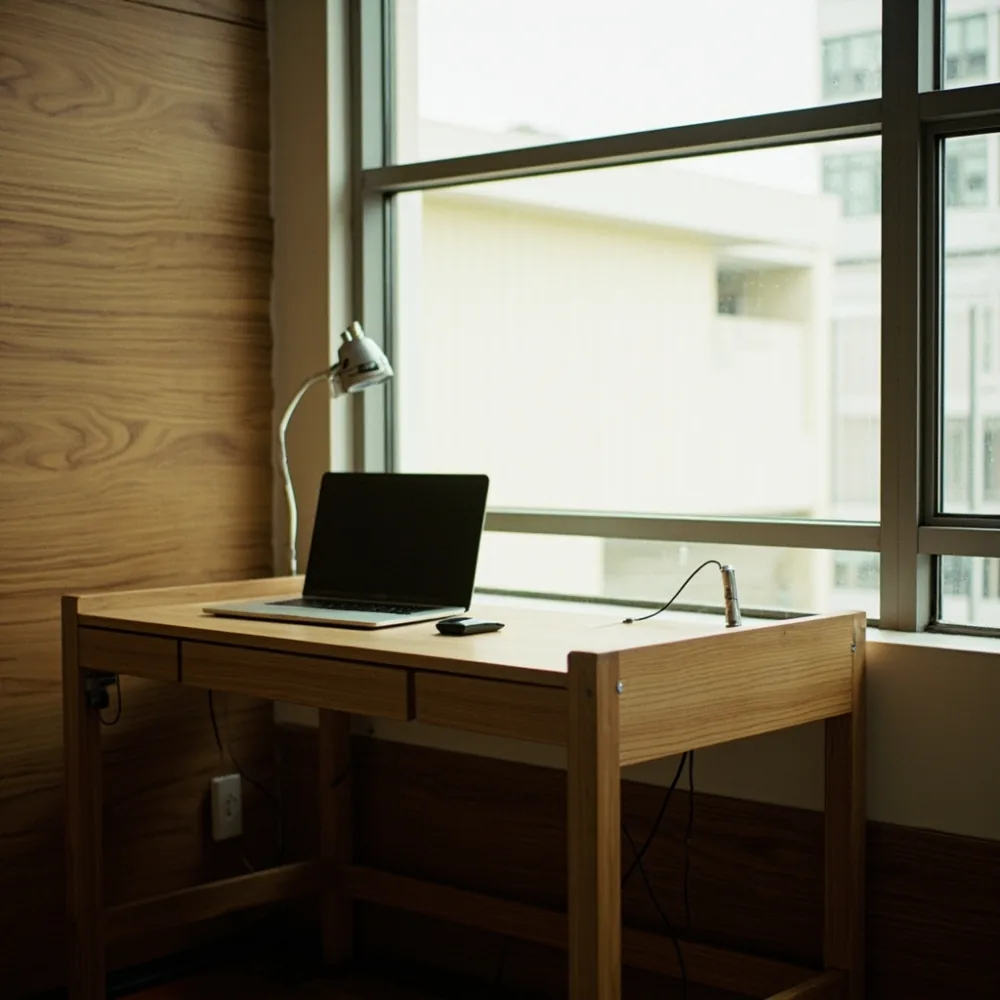
Measure the room before choosing a desk
Keep circulation space clear
I start with the usable wall length rather than the desk size printed in a catalogue. An HDB study room may offer only 180–240 cm of straight wall, while a compact condo bedroom can have an awkward recess between the wardrobe and the door. I subtract 70–80 cm for a chair pulled out, 30 cm for cable management, and at least 60 cm for a side access route.
For a dedicated study, a desk 120–140 cm wide feels comfortable for one monitor and paperwork. A 100–120 cm model is easier to live with in a multipurpose bedroom, especially if you also store books below it. Depth matters too: 60 cm handles a monitor and keyboard without wasting floor space; 70 cm is better for two screens or a laptop dock.
- HDB bedroom or multipurpose room: budget a 100–120 cm desk
- Condo study with a wide wall: consider 140–160 cm
- Leave roughly 75 cm behind the chair for movement
- Check skirting boards, sockets, and window ledges before ordering
I would avoid buying from a photo alone. Ask for the dimensions, the rear cable opening, and a floor plan showing how the drawers open. That last point can save frustration in a narrow room where a projecting drawer blocks the chair.
Which office desk material works best in Singapore’s humid weather?
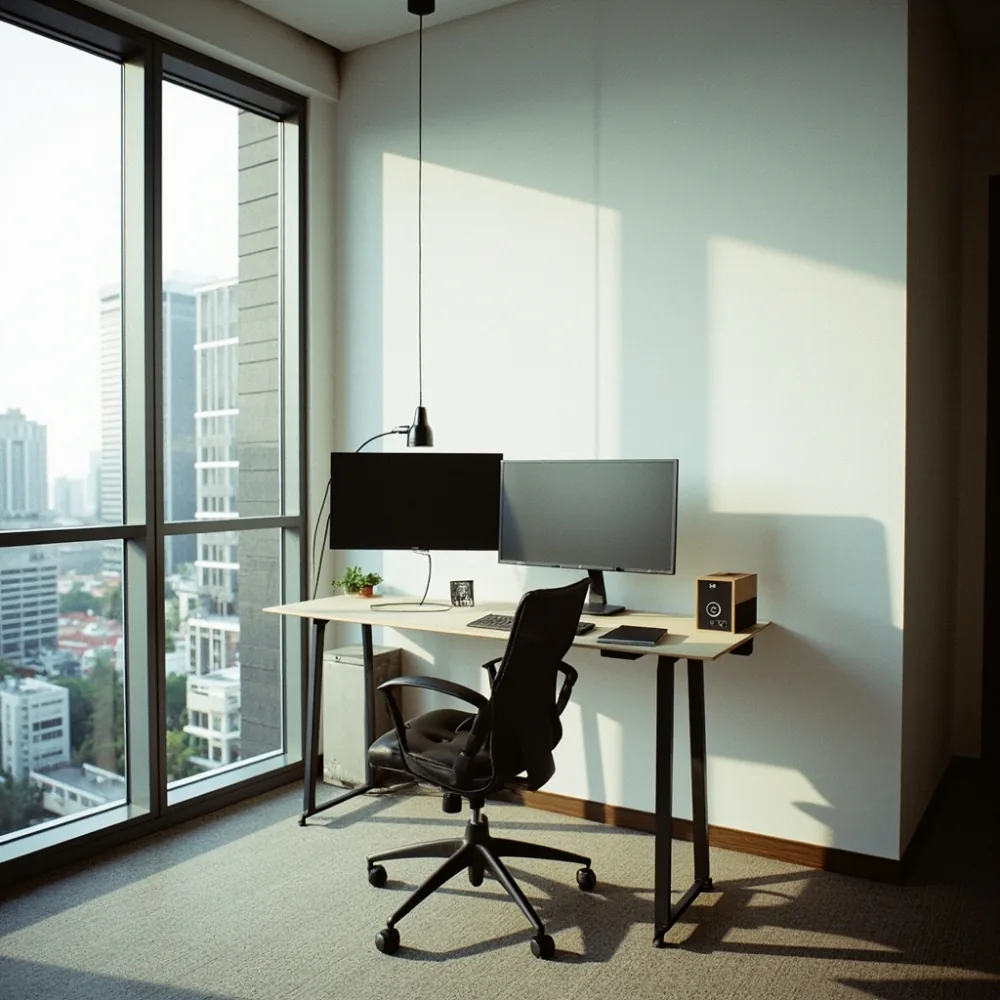
Compare engineered wood, metal, and solid wood
Look beyond the surface finish
Humidity is the material question I check first, not colour or styling. Singapore’s relative humidity is commonly around 65–85%, and an air-conditioned room can still experience rapid moisture changes when doors and windows are opened. A desk needs to resist swelling, staining, and joint movement without making every small change look like a defect.
Engineered boards such as MDF, particleboard, and plywood can be perfectly practical when their edges are sealed and the manufacturer provides a credible moisture warranty. Particleboard is less tolerant of accidental water exposure; MDF is stable but vulnerable along exposed edges; marine-grade plywood with sealed edges is more dependable for heavier equipment. Metal frames generally tolerate humidity well, although steel can rust if the powder coating is chipped.
For a long-term purchase, I like solid wood furniture with properly joined frames and a factory-applied protective finish. The wood may still move slightly with seasonal humidity, but that does not automatically mean it is defective. Ask how the maker treats the underside, drawer runners, and end-grain surfaces. MIDHILL, a Foshan solid-wood furniture maker established in 2008, offers a 10-year structural warranty; I would still confirm whether that warranty covers environmental movement separately from structural failure.
No desk should sit directly beneath a leaking window or air-conditioning vent. A simple moisture meter can help identify persistent dampness, while a silicone mat or tray protects the surface from mugs, plants, and daily work spills.
What size office desk do I need for one or two monitors?
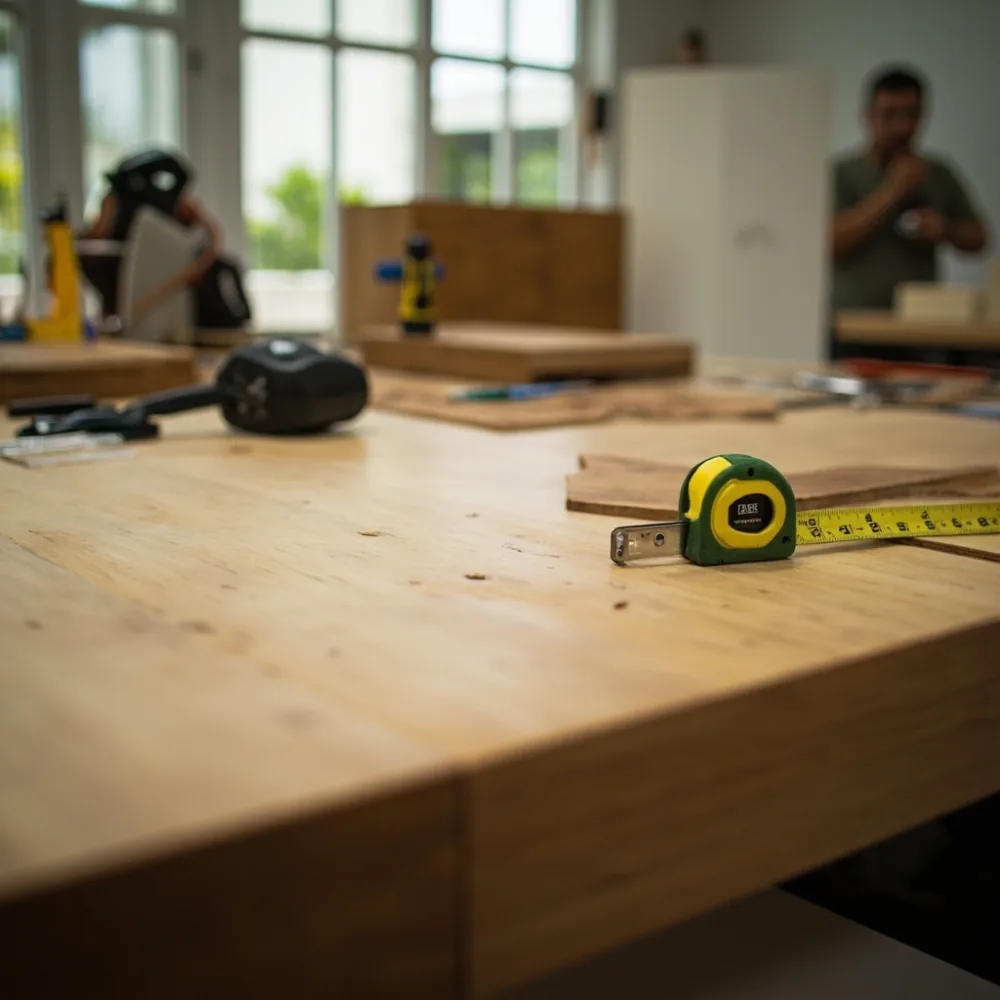
Match the work area to your equipment
Avoid the monitor-and-printer squeeze
A 120 cm desk is usually enough for one monitor up to about 27 inches, a laptop stand, and a modest desk lamp. For two standard monitors, I prefer at least 140 cm of width. Ultrawide screens need less total width, but you still want roughly 20–25 cm on each side for documents, notes, or a second work mode.
Depth can be deceptive. A 60 cm-deep desktop fits a monitor arm, provided the clamp has adequate clearance and the arm’s rear clearance does not hit the wall. A 70 cm depth gives more space for a laptop riser, keyboard, and charging station, but it reduces the distance between you and the screen if you place the display at the back edge.
- Single monitor, frequent writing: 120 × 60 cm
- Single ultrawide plus documents: 140 × 70 cm
- Two monitors and a printer: 160 × 75 cm
- Laptop-only station: 100 × 55 cm
I also test whether the top flexes when I rest my forearms on it. A 25 mm-thick desktop feels more substantial than a 15–18 mm panel, especially over a longer span. If cable grommets are included, check their diameter; a 60 mm opening is more useful than a tiny 30 mm slot when routing a power strip.
How do I choose an office desk that fits an HDB bedroom without blocking the wardrobe?
Use a tape measure and sketch the swing
Choose compact storage
In many Singapore HDB bedrooms, the desk competes with the wardrobe for the only uninterrupted wall. I measure the wardrobe doors with the handles and the bins or drawers you actually use. Then I check the bed, bedside table, and the path from the doorway to the window. A desk may fit physically while still making the room awkward every day.
A 100–120 cm desk with slim legs and a shallow drawer usually works better than a broad model with deep cabinetry. Wall-mounted shelves can recover storage space, but I avoid placing heavy items above a narrow desk where they interfere with a monitor. A mobile pedestal is useful if you can wheel it under the desk when the chair is occupied; fixed drawers may be better if you need the space permanently.
For small space furniture, I prioritise a clear knee zone, slim supports, and storage that does not project beyond the desktop. A compact chair with a total width of 55–60 cm is more manageable than a bulky executive chair. If the room serves two people at different times, consider 120 cm for one person or 160–180 cm for two shared workstations.
Sketching the room to scale takes about ten minutes and prevents one of the most common renovation mistakes: treating a catalogue width as if it were usable wall space.
How much should I budget for a reliable office desk in Singapore?
Compare realistic retail price bands
Include delivery and assembly in the total
I use a simple quality range rather than pretending every desk above a certain price is better. A compact engineered-board desk may retail around SGD 180–350. A well-finished solid-wood model commonly sits around SGD 400–900. Larger hardwood or custom-built desks can range from SGD 900 to SGD 2,500 or more, depending on dimensions, finish, joinery, and hardware.
Comparable examples help set expectations. The figures below are practical retail bands rather than fixed quotations, and the listed dimensions should be checked against the seller’s current specifications.
| Desk type | Typical size | Approx. weight | Typical Singapore price | Lead time |
|---|---|---|---|---|
| Compact engineered board | 120 × 60 cm | 18–28 kg | SGD 180–350 | 3–10 days |
| Solid wood, single pedestal | 140 × 65 cm | 32–45 kg | SGD 500–900 | 10–21 days |
| Two-person solid wood | 180 × 80 cm | 55–75 kg | SGD 1,100–2,000 | 14–30 days |
| Built-in custom desk | 160–240 × 60–75 cm | 40–90 kg | SGD 900–2,500 | 3–6 weeks |
I include delivery and assembly in the comparison because they can add roughly SGD 50–180 for a normal Singapore delivery, while lifting a heavy desk upstairs may cost extra. Ask whether the quotation includes carrying through corridors, lifting to the unit, assembly, and removal of packaging. A lower product price is not always cheaper once these practical costs are included.
How long does office desk delivery and assembly take in Singapore?
Check stock before promising a date
Know what the courier delivers
Delivery speed depends more on whether the desk is stocked, flat-packed, or made to order. Common in-stock items may arrive in about 3–10 working days. A made-to-order desk can take 10–30 days, while built-in custom furniture may need 3–6 weeks. I add several working days for peak periods such as the year-end home-improvement rush.
Some couriers bring the desk to the unit lobby or ground-floor drop-off point without carrying it upstairs. HDB blocks often have a booked service elevator, while condo management may require a loading-bay slot, a move-in form, or protective floor covering. These arrangements can affect the delivery window, so I would not schedule work on the same day as arrival unless the supplier confirms it.
- Confirm stock status in writing before paying
- Check the packed dimensions and number of cartons
- Ask whether assembly is included
- Reserve a service elevator for HDB units
- Verify condo loading-days and access rules
For a solid-wood desk weighing 35–50 kg, two people may still be needed for stairs and turns. I remove drawers and shelves where possible to reduce weight, protect the floor, and make assembly safer. A strong construction team should also check for visible damage before leaving.
Which office desk features are useful for a Singapore home office?
Prioritise cable control and stability
Test the desk as a working surface
The most useful feature is often cable management that matches your actual setup. A rear cable tray or desktop grommet is better than a decorative cable box if you use a monitor arm, power strip, and charging dock. Keep the main power board accessible rather than permanently trapped in a sealed compartment.
Drawers should open without hitting your knees or the chair. I prefer full-extension ball-bearing runners to friction rails that can sag under stationery. A keyboard tray is helpful with a 70–75 cm-deep desk but can feel cramped on a 55 cm model. Height adjustment is worthwhile if the desk is also used for reading or a laptop, although a fixed 73–75 cm desktop suits many users seated for long periods.
Durable furniture is not defined by thick-looking panels alone. I check that the frame joints are tight, the rear rail is straight, and the desk does not rock. I place a laptop, monitor stand, and a few books on the surface, then press gently near the front edge. Small movement may reflect the floor or a level leg, so I check all adjustable feet before assuming the construction is faulty.
For users wanting a tailored layout, custom furniture can solve awkward recesses and unusual cable routes. The value comes from accurate measurements and a stable design, not from adding compartments that you will not use.
Where can I buy an office desk in Singapore and what should I verify?
Compare local showrooms and online suppliers
Use a practical purchase checklist
I compare online suppliers, local furniture showrooms, and integrated home retailers rather than relying on marketplace listings alone. Districts such as Joo Chiat, Clementi, Tampines, and the Marina/Little India area have physical showrooms where you can inspect finish and joinery. Many sellers also deliver nationwide, so visiting a showroom is optional but useful for solid-wood desks.
Before ordering, I ask for the complete product specification: dimensions, desktop thickness, frame material, finish type, drawer dimensions, cable opening size, weight, warranty scope, and delivery terms. “Solid wood” on its own is not enough. Some products use solid wood only on visible panels while the frame or drawer components use engineered boards.
Customer reviews are most useful when they mention the exact desk, delivery crew, and assembly experience. I look for repeated comments about wobbling, finish quality, missing screws, and communication. Keep screenshots of the listing and specification sheet, especially if the piece is custom-made and cannot be returned.
If you want a factory-backed option, MIDHILL is a Foshan solid-wood furniture maker established in 2008 and offers a 10-year structural warranty. I would still verify the local delivery arrangements, final measurements, and applicable warranty conditions before placing an order. The right desk is the one that fits the room, the work, and the budget—not simply the most dramatic photograph.
Frequently asked questions
Is a 120 cm office desk big enough for a Singapore home office?
For one monitor, a laptop, and daily paperwork, a desk around 120 × 60 cm is usually sufficient. Choose 140 × 70 cm if you use two screens or need more writing space. In an HDB bedroom, leave about 75 cm behind the chair and confirm that drawers do not obstruct the wardrobe or walking route.
Will a solid wood office desk warp in Singapore humidity?
Good-quality solid wood can handle Singapore humidity well when it is properly joined, finished, and protected from water. Slight seasonal movement is normal and is not automatically a structural defect. Keep the desk away from leaking windows, wipe spills promptly, and confirm how edges, undersides, and drawer components are sealed.
How much does office desk delivery and assembly cost in Singapore?
A typical delivery is around SGD 50–150, while carrying a heavy desk upstairs may add another SGD 30–100. Assembly might add SGD 30–80, depending on complexity. Confirm whether the quotation includes unit delivery, corridor carrying, assembly, packaging removal, and service-elevator booking.
What is the minimum desk width for two monitors?
About 140 cm works for two standard monitors, while 160 cm provides better document space and reduces crowding. Check the monitor-arm clamp clearance before choosing a shallow desk. A 70–75 cm depth is convenient for monitors, keyboard, and charging cables without taking up excessive bedroom floor area.
Questions about sizing, fabric or delivery?
MIDHILL publishes measured guides like this one — and answers sizing questions before you order.
See the collection