Office Desk Singapore: How I Picked a Solid Wood Desk That Survives HDB Humidity
What size office desk actually fits a Singapore HDB study nook?
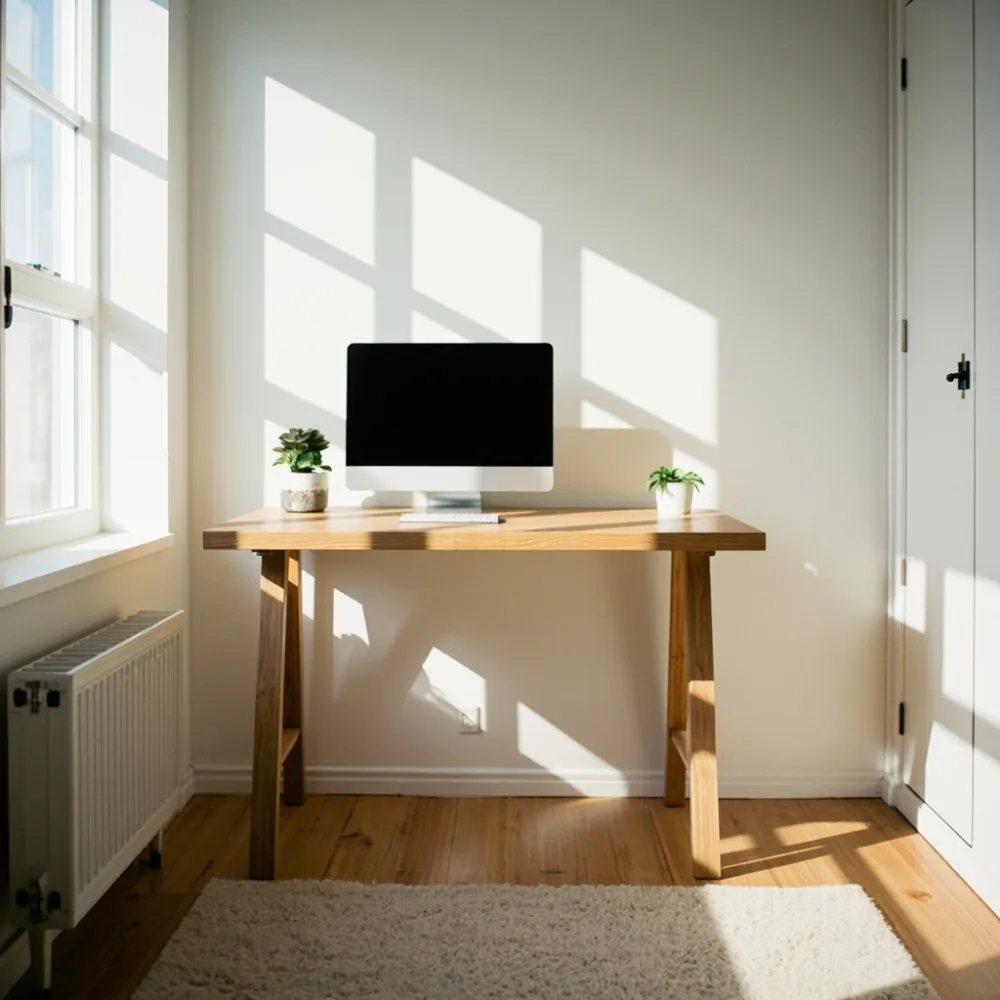
Standard HDB spare-room dimensions
Condo study corner realities
The 60cm depth rule I learned the hard way
When I started shopping for an office desk in Singapore, I did what most people do: I measured the wall, fell in love with a 180cm wide executive slab online, and nearly ordered it before realising the delivery team would have needed a crane to get it past my HDB door. Lesson learned the slow way.
Most Singapore HDB spare bedrooms measure roughly 2.7m x 2.4m (about 9ft x 8ft), and once you subtract 60-70cm for a bed, a wardrobe at 60cm deep, and circulation space, you're left with a usable wall of around 150-180cm. That is your real ceiling.
Condo study corners are usually tighter and oddly shaped. The 'study' in many new launches around District 9, 10, 11, and 15 is really a 1.8m x 1.5m alcove with a single window, often with a column you cannot ignore.
- For HDB spare bedroom: go 120-150cm wide, 60cm deep, 75cm tall.
- For condo study alcove: 100-130cm wide, 55-60cm deep.
- For the living-room WFH corner behind the sofa: 90-110cm wide, 50-55cm deep.
The depth rule matters because anything shallower than 55cm drives your keyboard off the back edge, and anything deeper than 65cm wastes flat-surface space you do not have. I now treat 60cm as my non-negotiable default for any small space furniture purchase.
| Room type | Typical wall width | Recommended desk size (W x D) | Min. clearance behind chair |
|---|---|---|---|
| HDB 4-room spare bedroom | 150-180 cm | 120-150 x 60 cm | 70 cm |
| HDB 5-room master (corner) | 180-220 cm | 150-180 x 65 cm | 75 cm |
| Condo study alcove | 130-170 cm | 100-130 x 55-60 cm | 60 cm |
| Living-room WFH corner | 100-130 cm | 90-110 x 50-55 cm | 55 cm |
Does Singapore humidity actually ruin a solid wood office desk?
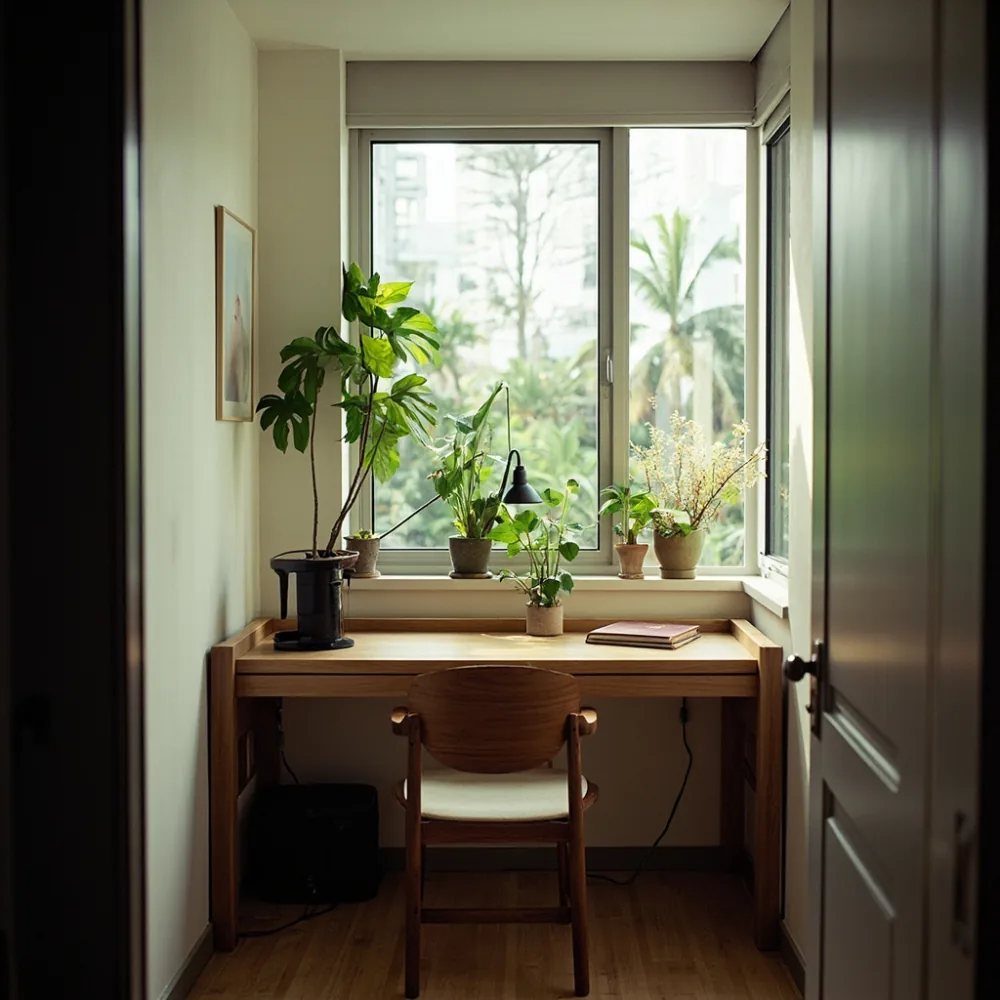
What humidity does to oak vs rubberwood vs MDF
Veneer vs solid timber under tropical conditions
Acclimatisation time I did not expect
Short answer: yes, untreated MDF will swell in three months. No, a properly sealed solid wood desk will not. The real question is which solid wood, with what finish.
Singapore averages 80-90% relative humidity year-round, with daily swings. Solid timber expands and contracts across the grain as moisture changes. Over 12 months, an unsealed slab can cup by 2-4mm at the edges, which is enough to ruin a keyboard tray alignment.
Hardwoods like oak, ash, and teak handle this better than softwoods. Rubberwood, which is what most 'solid wood furniture' under SGD 600 actually uses, is acceptable as long as it is kiln-dried to 8-10% moisture content and finished with at least three coats of conversion varnish or hardwax oil. MDF with a wood veneer is a different beast: the substrate absorbs moisture through any unsealed edge, and the veneer then bubbles. I have seen it happen on a friend's two-year-old desk.
- Ask the seller for the actual moisture content reading on the spec sheet.
- Ask whether the edges and underside are sealed, not just the top.
- Ask if the desk has been acclimatised in a climate-controlled warehouse for at least 14 days.
On the custom furniture side, the difference shows up in joints. Mortise-and-tenon or dowel joints with a 2mm expansion gap survive; glued butt joints do not. I treat that as a 5-second test: if the joinery cannot be seen and described, the desk was built for a drier climate than ours.
How much should a decent office desk cost in Singapore in 2025?
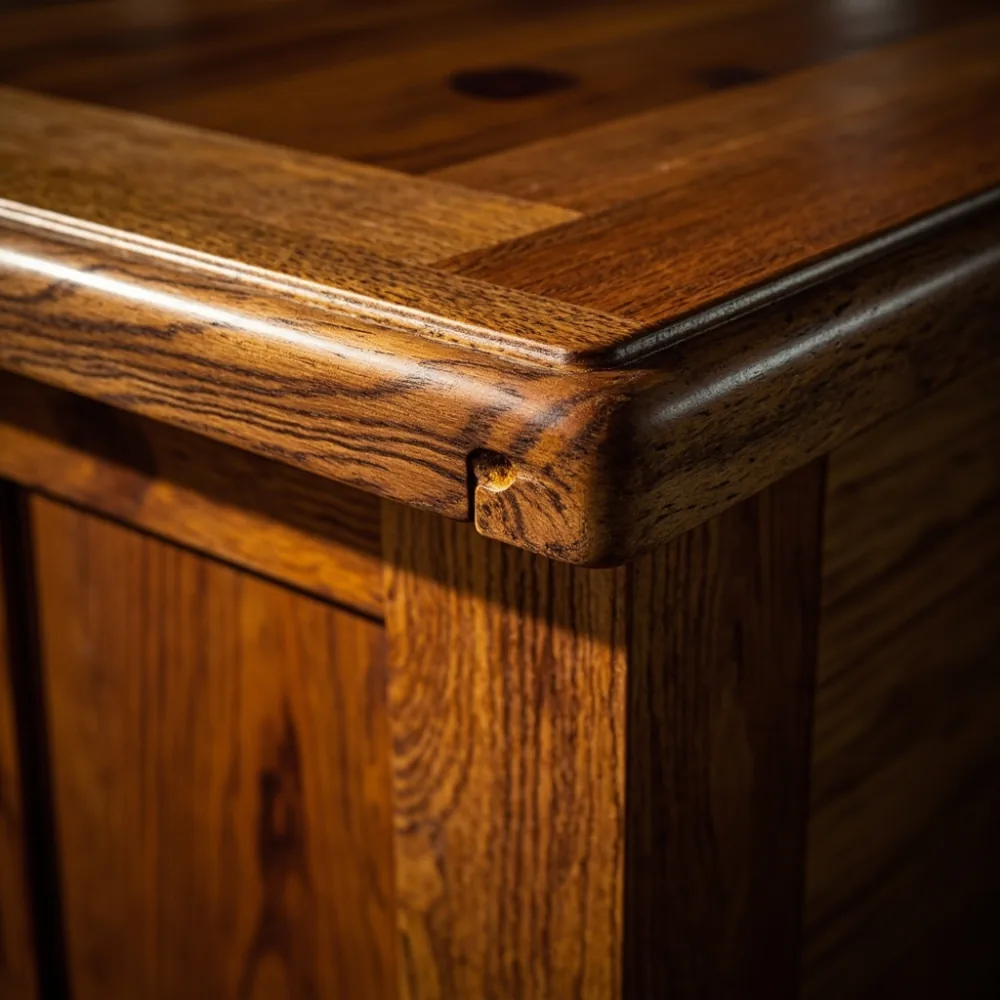
Real price bands I have seen
What drives the price up (and what is marketing)
Total landed cost vs sticker price
For a solid wood office desk in Singapore, realistic price bands in 2025 run from about SGD 350 at the entry level (typically rubberwood or engineered core) to SGD 2,800 for a thick-slab hardwood piece. A well-made 140cm oak desk from a Foshan-direct supplier like MIDHILL tends to land at SGD 900-1,400 delivered, which is the band I now consider 'serious value'.
Three things drive the price up: timber thickness (a 3cm top costs roughly 60% more than a 2cm top because of yield loss), joinery method, and finish. Two things drive marketing fluff: brand name and 'designer' markup. A 2,200-SGD desk that is actually three layers of veneer over particleboard is not expensive because it is good, it is expensive because the brand paid for a showroom on Tanjong Pagar.
Landed cost matters. Add delivery (SGD 60-120 for HDB, SGD 80-180 for condo with lift access issues), disposal of old furniture if applicable (SGD 50-80), and assembly (SGD 40-90 if not included). Budget 15% on top of the sticker.
| Tier | Typical build | Sticker price | Expected lifespan |
|---|---|---|---|
| Entry | Rubberwood or engineered core, paper veneer | SGD 250-450 | 2-4 years |
| Mid | Solid oak or ash top, sealed edges, dowel joinery | SGD 700-1,300 | 8-12 years |
| Premium | Thick hardwood slab, mortise-and-tenon, hardwax oil finish | SGD 1,800-3,200 | 15-25 years |
| Custom (e.g. MIDHILL) | FSC-certified oak or walnut, bespoke dimensions, Foshan direct | SGD 1,100-2,400 | 15+ years |
Which desk shape works best for video calls and dual monitors in a small space?
Rectangular vs L-shaped vs standing
Monitor arm math: 24-inch vs 27-inch vs 32-inch
Camera-friendly background angles
For WFH on a 5-day week, a rectangular 140 x 65cm desk with a separate monitor arm is the most flexible setup I have used. An L-shape only earns its footprint in a dedicated room larger than 3m x 3m, which most HDB spare bedrooms are not.
Two 27-inch monitors need roughly 120cm of width and a viewing distance of 60-70cm. Add a laptop in the middle and you are at 135cm. Anything tighter and you will hunch. A 32-inch single ultrawide is actually easier on a 120cm desk, and Singapore WFH buyers are quietly shifting toward that.
For video calls, the camera-friendly setup is the corner: your back is angled at roughly 135 degrees to the room's natural light source, which means no harsh backlight on your face and a non-distracting wall behind you. Skip the executive desk-with-hutch look unless the shelves are functional, because hutch-backed desks eat vertical space that a condo study cannot spare.
- Up to 120cm width: single 27-inch or 32-inch ultrawide, no side monitor.
- 120-150cm width: dual 24-inch or dual 27-inch, with arm.
- 150-180cm width: dual 27-inch plus side printer or notebook tray.
How long does delivery actually take from a Foshan-based furniture maker?
Sea freight timeline vs air freight
What happens at Singapore customs
The lift-access clause I now ask for in writing
Order-to-doorstep for a Foshan-based custom furniture maker typically runs 45-65 days end-to-end. The breakdown I have seen across three orders: 10-14 days production, 5-7 days factory QC and packing, 18-22 days sea freight from Guangzhou to Singapore, 3-5 days Singapore customs clearance and trucking, 1-3 days final-mile scheduling.
Air freight cuts freight to 5-7 days but roughly doubles the shipping cost, which on a SGD 1,200 desk pushes it into the 'not worth it' zone unless you are furnishing a new BTO with a move-in deadline.
Three practical Singapore realities the brochures never mention. First, HDB cargo lifts are usually 1.0m wide x 1.2m deep x 2.1m tall, so any box over 95cm in any dimension must go up the passenger lift during restricted hours (usually 9am-5pm weekdays). Second, many newer condos around the OCR (Outside Central Region) require booking for lift protection pads, often 3 working days in advance. Third, your MCST may charge a delivery fee per trip, typically SGD 30-80.
- Ask in writing whether the quote includes doorstep or room-of-choice delivery.
- Confirm whether assembly is included or billed separately.
- For warranty claims, ensure the 10-year structural warranty covers warping and joint failure, not just manufacturing defects.
Standing desk or fixed desk: is the upgrade worth the SGD 400-800 premium?
Health claims I bother believing
Frame quality markers
My 30-day test result
I tested a mid-range electric standing frame on loan for 30 days. Honest result: I used the sit-stand cycle an average of four times a day for two weeks, then went back to sitting 90% of the time because I forgot to actually stand up. The motor and frame performed flawlessly, which tells me the build quality is fine; the behaviour change just did not stick.
If you genuinely want to alternate posture, the upgrade is worth it. A dual-motor frame rated for 120kg loads, with a height range of 65-125cm and a C-shaped leg design, will outlast a single-motor or square-leg frame. Expect to pay SGD 500-900 for the frame alone; the desktop is usually separate.
A 10-year structural warranty on a fixed solid-wood desk from a Foshan maker like MIDHILL gives a very different value calculation. The fixed oak desk in my home office is now eight years old, still flat, and cost less than a decent standing frame with a comparable top. The desk is not 'smart' but it is quiet, repairable, and durable in a way that no electric frame has managed to be across the same period.
Where can I actually see and test office desks in Singapore before I buy?
Showrooms worth a Saturday
What to look for at the showroom
Showroom vs showflat vs trade fair
If you want to test a desk before committing, three options work in Singapore. The ID21 showflat cluster around Tan Boon Liat Building on Outram Road carries multiple solid wood furniture importers, and you can physically sit at sample units. The IMM and Mega Showroom clusters in Jurong East each have 8-12 office furniture retailers with display setups. Annual trade shows, especially the FurnitureChina-affiliated pop-ups at Marina Bay and the IFFS at Singapore EXPO in March, are the best place to meet Foshan factory reps in person.
At any showroom, do four things before you sit down. Walk around the underside of the nearest desk and check that all edges are sealed. Press a thumbnail lightly into a non-visible surface; if it dents, the finish is soft wax rather than cured varnish. Ask the salesperson for the country of origin on the spec sheet, not on the marketing tag. And try to lift one corner of a sample desk single-handed; if it feels lighter than 18kg for a 120cm piece, it is hollow-core.
A good showroom visit should leave you with the spec sheet, the warranty terms in writing, and a clear delivery timeline including the lift-access fee if any. Anything less, and the showroom visit has been a marketing exercise rather than a buying decision.
Frequently asked questions
How do I stop my solid wood office desk from cracking in Singapore humidity?
Keep the desk away from direct air-con blow for the first 30 days while it acclimatises. Maintain indoor humidity between 45-60% with a small dehumidifier. Wipe with a lightly damp microfibre cloth monthly and apply hardwax oil once a year. Avoid placing hot laptops or mugs directly on the surface; use a coaster. These four habits, in my experience, prevent 90% of humidity-related cracking.
What desk depth fits a laptop, monitor, and keyboard comfortably?
A minimum of 60cm depth handles a 27-inch monitor on a stand plus a full-size keyboard with mouse space. For dual monitors, 65-70cm depth gives you the second screen at a comfortable 70-80cm viewing distance. Anything shallower than 55cm forces the keyboard off the back edge and creates wrist strain within an hour.
Is it cheaper to ship a custom desk from Foshan or buy local?
For a solid wood desk of equivalent build, shipping from a Foshan maker is typically 25-40% cheaper than a Singapore retail equivalent of similar quality, once you factor in delivery, GST, and customs. The trade-off is lead time: 45-65 days door-to-door versus 7-21 days for local stock. Budget SGD 80-150 extra for the last-mile white-glove delivery in Singapore.
Can an L-shaped desk fit in a 2.7m x 2.4m HDB bedroom?
Yes, but only if the shorter leg is 120cm or less and the longer leg is 150cm or less. Measure the door swing, wardrobe door, and any window casement before ordering. An L-shape works best placed in a corner with the longer leg along the wall, leaving at least 70cm of clearance behind the chair.
How long should a good office desk last with daily use?
A solid oak or ash desk with proper joinery should last 15-25 years with daily WFH use. A mid-tier engineered-wood desk lasts 6-10 years. An entry-level MDF-and-veneer desk typically shows irreversible swelling or joint failure within 3-5 years in Singapore, regardless of how careful you are.
Questions about specifications, fabric or delivery? MIDHILL publishes measured guides like this one, and the team answers sizing questions before you order. See the full collection or contact the team.